
Nigeria Loses N3.2tn, 388 Lives To Fire Outbreaks In Five Years
…11,014 Incidents Recorded, N19tn Assets Saved
…3,800 Lives Saved, Power Surge Responsible For Highest Fire Incidents
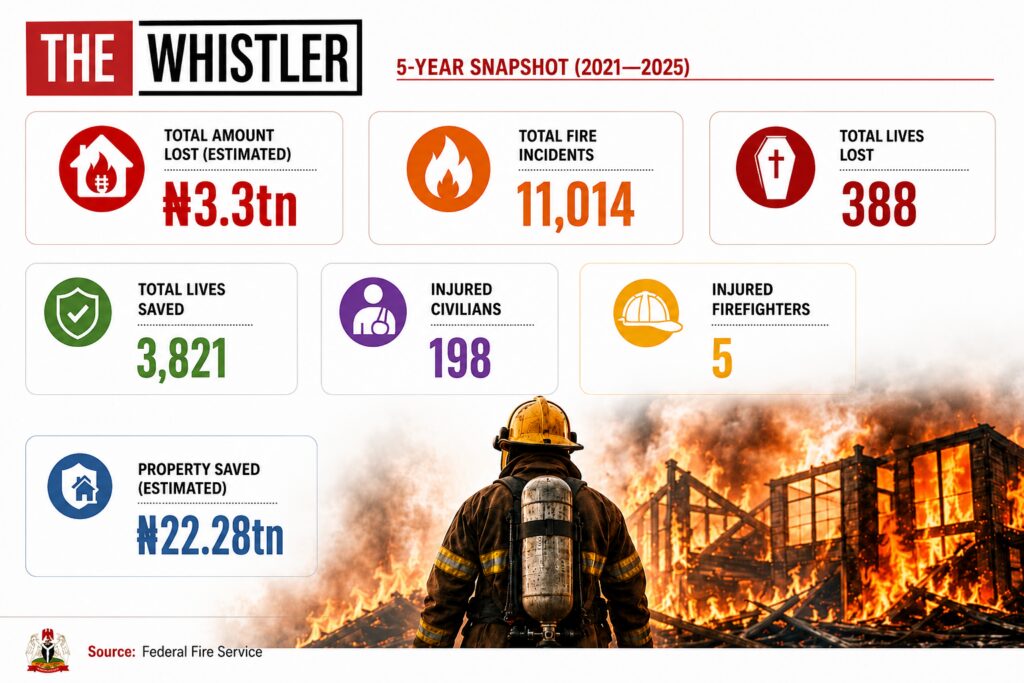
Nigeria lost an estimated N3.2tn worth of property and 388 lives to fire outbreaks between 2021 and 2025, even as firefighters saved assets valued at about N19tn and rescued more than 3,800 people during the period, a five-year analysis of national fire statistics has shown.
The data, obtained by THE WHISTLER from annual records of the Federal Fire Service Data Collation Centre in Abuja, showed that the country recorded a total of 11,014 fire incidents within the five-year period.
The records further revealed that although fire incidents declined after peaking in 2022, fatalities surged sharply again in 2025, raising concerns about fire prevention, emergency response capacity, public safety awareness, and the growing severity of fire outbreaks across the country.
Advertisement
According to the records, Nigeria recorded 2,845 fire incidents in 2021, with 136 lives lost, 587 lives saved, and 260 rescues.
In 2022, fire incidents rose slightly to 2,860, the highest within the five-year period, but deaths dropped to 81, while 418 lives were saved and 139 rescues recorded.
The number of incidents declined sharply to 1,746 in 2023, with 39 deaths, 394 lives saved, and 224 rescues.
In 2024, incidents fell further to 1,697, while deaths dropped to 18, the lowest figure recorded within the period. The service also reported 316 lives saved and 56 rescues that year.
However, the downward trend reversed in 2025. Although the country recorded 1,866 fire incidents, civilian deaths rose sharply to 114. The 2025 report also recorded 198 injured civilians, 2,106 lives saved, and five injured firefighters.
Advertisement
2025 Emerges Deadliest Years
An analysis of the figures by THE WHISTLER showed that although fire incidents reduced after 2022, the human cost increased significantly in 2025.
Fire outbreaks declined from 2,860 in 2022 to 1,746 in 2023, before dropping further to 1,697 in 2024. The figure rose slightly to 1,866 in 2025, but remained lower than the numbers recorded in both 2021 and 2022.
The fatality trend, however, followed a different pattern. Deaths dropped from 136 in 2021 to 81 in 2022, then to 39 in 2023, and further to 18 in 2024. But in 2025, fatalities surged to 114, making it the second-deadliest year within the five-year period.
The development suggests that the concern in 2025 was not merely the number of fire incidents, but the severity, location, and nature of the outbreaks, as well as possible challenges relating to emergency response, evacuation, access to water, public preparedness, and firefighting equipment.
Deaths increased from 18 in 2024 to 114 in 2025, representing a rise of 96 deaths or about 533 per cent.
Advertisement
Within the same period, fire incidents rose from 1,697 to 1,866, an increase of 169 cases or about 10 per cent.
The disparity suggests that fires recorded in 2025 were deadlier, possibly affecting more vulnerable locations or involving more dangerous ignition sources.
Fatality Rate Climbs To Highest Level
Although 2022 recorded the highest number of fire incidents at 2,860, the highest number of deaths was recorded in 2021 when 136 lives were lost.
This indicates that the volume of fire outbreaks alone does not determine the level of casualties.
The 2025 figures appear particularly concerning because, despite recording fewer incidents than 2021 and 2022, the year still witnessed a significantly high death toll.
Based on the available data, 2025 recorded the highest fatality rate per 100 fire incidents within the five-year period.
In 2021, Nigeria recorded about 4.8 deaths per 100 fire incidents. The rate declined to 2.8 in 2022, 2.2 in 2023, and 1.1 in 2024, before rising sharply to 6.1 deaths per 100 incidents in 2025.
Residential Buildings Top Fire-Risk Locations
Across the five years under review, private homes consistently recorded the highest number of fire outbreaks.
In 2021, residential buildings accounted for 1,063 incidents. The figure rose slightly to 1,114 in 2022.
The trend continued in 2023 with 575 residential fires and 585 in 2024. In 2025, private homes and residences again topped the list with 693 incidents.
The pattern suggests that homes remain the most common locations for fire outbreaks in Nigeria, possibly due to unsafe electrical wiring, power surges, overloaded sockets, poor handling of cooking gas, candles, and open flames, as well as limited household fire-safety preparedness.
The figures indicate that fire prevention campaigns may need to pay greater attention to residential areas alongside markets, filling stations, and public buildings.
Markets Record Heavy Human, Economic Losses
Although residential buildings recorded the highest number of incidents in 2025, markets and trading centres suffered some of the heaviest human and economic losses.
The records showed that markets and trading centres accounted for 190 fire incidents, resulting in 39 civilian deaths, 55 injuries, 148 lives saved, and estimated property losses valued at N22.27bn.
Market fires are often devastating because they destroy goods, livelihoods, and investments accumulated over many years. Such incidents also spread rapidly due to congestion, poor electrical connections, blocked access routes, and inadequate firefighting facilities.
Public Buildings, Vehicles Contribute To Casualties
The data also showed that vehicles and public buildings contributed significantly to the casualty figures recorded in 2025.
Vehicle-related fires accounted for 177 incidents, resulting in 22 deaths and 16 injuries.
Public buildings and government offices recorded 444 fire incidents, with 18 deaths, 27 injuries, and 714 lives saved.
The figures suggest that the 2025 spike in fatalities was not limited to one category of premises but cut across residential buildings, markets, vehicles, and public institutions.
Public buildings are particularly significant because they are expected to have safety systems, emergency exits, and fire-prevention procedures. Fatalities recorded in such locations may raise questions about compliance with safety standards, inspection routines, and emergency preparedness.
Electrical Faults, Power Surges Remain Major Causes
The data further showed that electrical faults and power-related problems remained the leading causes of fire outbreaks across the country.
In 2025, electrical equipment and wiring faults accounted for 627 incidents, while power surge and overload cases caused 677 fires.
Combined, both categories accounted for 1,304 of the 1,866 incidents recorded that year, representing about 70 per cent of all fire outbreaks.
A similar pattern was recorded in previous years.
In 2024, power surges caused 401 fires, while electrical equipment malfunctions accounted for 334 incidents.
In 2023, power surges caused 456 fires, while electrical faults were linked to 278 incidents.
The trend suggests that unstable electricity supply, poor wiring systems, overloaded circuits, substandard electrical materials, and weak enforcement of safety standards remain major drivers of fire outbreaks in Nigeria.
It also highlights the need for preventive measures beyond emergency response, including safer buildings, regular electrical inspections, public awareness campaigns, and stricter regulation of electrical installations.
Rising Number Of Unknown Causes Raises Concern
Another major concern in the data is the high number of fires classified as “unknown” or “undetermined.”
In 2025 alone, unknown causes accounted for 269 incidents, resulting in 69 deaths and 46 injuries.
The category recorded the highest number of deaths by ignition source during the year.
The development raises concerns about post-fire investigations, forensic capacity, incident documentation, and reporting standards.
Experts say that where causes remain undetermined, it becomes more difficult for authorities and the public to identify risks and develop targeted prevention strategies.
Property Losses Remain Substantial
The financial cost of fire outbreaks also remained substantial throughout the five-year period.
In 2022, estimated property losses stood at N69.4bn, while property valued at N593.9bn was saved.
In 2023, estimated losses rose to N88.37bn, while property worth about N1.2tn was saved.
In 2024, estimated losses stood at N67.43bn, with property valued at N1.94tn saved.
In 2025, property losses were estimated at N74.75bn, while assets worth N934.70bn were saved.
The 2021 report, however, recorded exceptionally large figures, with estimated property losses put at N3,045.27tn and property saved valued at N18,996.47tn.
Among the verified recent figures between 2022 and 2025, 2023 recorded the highest property loss at N88.37bn.
This was followed by N74.75bn in 2025, N69.4bn in 2022, and N67.43bn in 2024.
The figures indicate that property losses do not necessarily move in line with the number of fire incidents, as the scale of destruction often depends on the type, value, and location of affected property, as well as how quickly the fire is contained.
2025 Records Highest Number Of Lives Saved
Despite the spike in fatalities, 2025 also recorded the highest number of lives saved within the five-year period.
The Federal Fire Service reported that 2,106 lives were saved in 2025, compared with 316 in 2024, 394 in 2023, 418 in 2022, and 587 in 2021.
The sharp rise in lives saved suggests increased rescue activity, improved reporting, or more incidents involving people trapped in high-risk situations.
However, the same year also recorded 114 deaths, indicating that more people were both rescued and killed in 2025 than in previous years.
Overall, the five-year national fire statistics show that while Nigeria recorded fewer fire incidents after 2022, the sharp rise in fatalities in 2025 has complicated the broader picture of fire safety and emergency response in the country.