
2027: Jonathan Warns Of Crisis If Judiciary Determines Winners
…Nigerians Losing Faith In Elections — Adoke
…Judiciary Increasingly Deciding Electoral Outcomes, Says NBA President
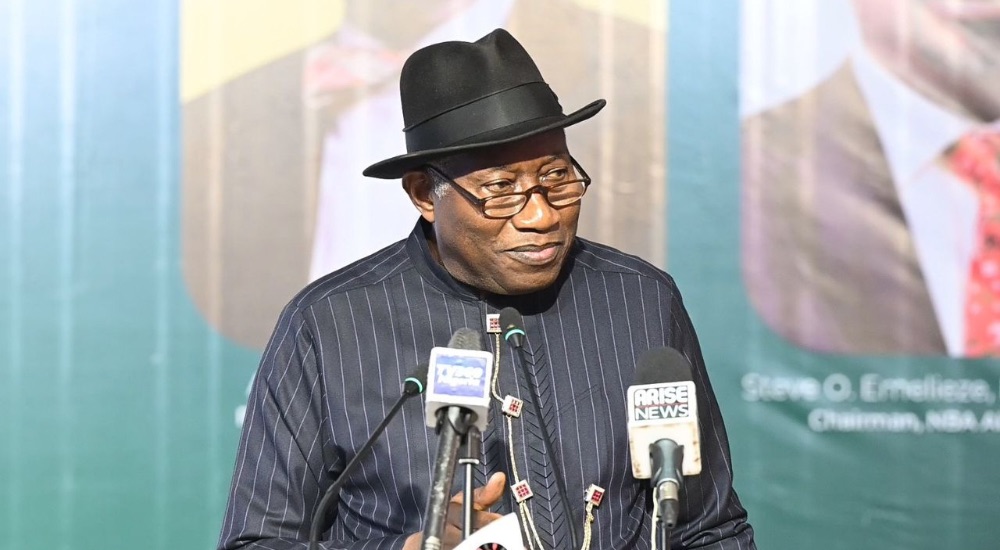
Former President Goodluck Jonathan on Wednesday warned that Nigeria’s democracy could face a deeper legitimacy crisis if the judiciary continues to determine electoral winners instead of the ballot.
According to him, politicians now head to court because they believe judges can overturn the will of the people.
Jonathan spoke at the opening ceremony of the Nigerian Bar Association (NBA) Abuja Law Week 2026 held at the NBA House, Abuja, with the theme: “Safeguarding Nigeria’s Democratic Process.”
The former president, who attended as Special Guest of Honour, said electoral integrity, judicial independence and institutional reforms were critical to preserving Nigeria’s democracy ahead of the 2027 general elections.
Advertisement
According to him, the increasing number of post-election litigations in Nigeria had become abnormal and dangerous to democratic stability.
“At the end of every round of elections, the number of cases that go to court is overwhelming.
“Some of the people go to court, even their family members don’t vote for them. But they go to court simply because we believe that the judiciary could be manipulated to declare people who ordinarily are supposed not to win the election as those who have won the election,” Jonathan said.
Jonathan recalled how a former South African deputy president was shocked that Nigerian politicians routinely challenge election outcomes in court.
Advertisement
“She asked me, ‘Why would somebody go to court after losing an election?’ In South Africa, going to court after losing an election is strange. While in Nigeria, not going to court is strange,” he said.
Jonathan argued that courts should not declare winners in disputed elections but should instead order fresh polls where irregularities are established.
“The judiciary will do their work, but they should not declare any candidate. If they are not satisfied with the process of the election, then they should go back to the field. Let the ballot decide who wins,” he stated.
The former President also questioned Nigeria’s multi-layered electoral litigation structure, describing it as inconsistent and cumbersome.
“Governorship election takes three levels — tribunal, Appeal Court and Supreme Court. Presidency takes two. Are you telling me electing a governor is more important than electing a President?” he queried.
Jonathan further lamented low voter turnout in Nigeria, describing it as the worst on the African continent despite the country’s population advantage.
Advertisement
“Nigeria has the least voter turnout in Africa. INEC needs to investigate why we have the least. I cannot just say it is voters’ apathy alone,” he said.
He blamed electoral violence and political thuggery for weakening public trust in elections, saying the country had normalised a dangerous culture where political thugs wield enormous influence.
He said, “Nigeria is the only country where thuggery is a profession.
“Some thugs, when they are travelling out of this country, fly first class while university professors struggle to buy economy tickets. That country is like a canoe turned upside down.”
The former President stressed that democracy was not sustained merely through periodic elections but through strong institutions, credible electoral processes, accountability and rule of law.
“The INEC must remain independent not only in name but in practice. Once citizens lose confidence in the electoral process, democracy itself becomes endangered,” he warned.
He also cautioned the judiciary against becoming an instrument for political manipulation.
“The courts must never become instruments for political manipulation or partisan interests. Justice must not only be done, it must be seen to be done fairly, courageously and without external influence,” he added.
Jonathan urged the NBA to work closely with the National Assembly in reviewing Nigeria’s electoral and judicial laws, including the possibility of creating a Constitutional Court to exclusively handle electoral disputes.
He also advocated a closer relationship between government and the NBA, suggesting that the NBA President should serve as an honorary adviser to the President to help avert constitutional and governance crises before they escalate.
Earlier in his keynote address, former Attorney General of the Federation and Minister of Justice, Mohammed Adoke, warned that Nigeria’s democracy was standing at a “precarious crossroads,” saying public confidence in elections had continued to erode.
Adoke said although Nigeria had sustained democratic rule since 1999, continuity alone did not amount to democratic credibility.
Adoke said, “A democracy is not measured merely by how often it holds elections, but by how deeply its people trust the outcome of those elections.
“The real question before us is not whether Nigeria is democratic. It is far more serious than that. Are we safeguarding the democratic process or merely managing appearances?”
Citing the 2023 general elections, Adoke said the polls recorded only 27 per cent voter turnout, the lowest since 1999, while violence reportedly claimed 89 lives.
According to him, vote-buying, electoral violence, weak internal party democracy and poor enforcement of electoral laws had continued to undermine Nigeria’s democratic process.
“Vote-buying has transformed elections into economic transactions rather than democratic choices,” he said.
The former AGF also criticised political parties for allegedly imposing candidates and circumventing democratic primaries contrary to provisions of the Electoral Act 2022.
He warned that overreliance on the judiciary to resolve political disputes was gradually eroding the role of voters in determining electoral outcomes.
“The phrase ‘go to court’ has become a silent reminder that the electorate’s participation in determining leaders is gradually eroding,” he stated.
Adoke praised Jonathan’s conduct during the 2015 presidential transition, describing him as “a democratic legend” who respected the rule of law and prioritised national peace above personal ambition.
“In 2015, despite having enough room to challenge the electoral process, he opted to leave the scene without creating a crisis in the interest of the country,” he said.
Also speaking, President of the Nigerian Bar Association, Afam Osigwe, said it was troubling that 27 years after Nigeria’s return to civil rule, concerns about safeguarding democracy still dominated national discourse.
“It speaks volumes about how far we need to go and about the worries Nigerians have concerning the democratic process,” Osigwe said.
He said there was an urgent need to deepen democracy, strengthen institutional independence and ensure that electoral outcomes genuinely reflected the will of the people.
According to him, Nigerians were increasingly worried that the democratic process had become excessively judicialised.
“The judiciary now plays a critical and increasing role in determining who represents us,” he said.
Osigwe condemned electoral violence, thuggery and manipulation, warning that power must never be obtained outside constitutional and democratic processes.
“Without people mounting a military coup, people through violence, thuggery and electoral manipulation come to power in Nigeria,” he stated.
The NBA President commended Jonathan for conceding defeat in 2015, recalling the former president’s famous declaration that “his ambition was not worth the blood of any Nigerian.”
“That should be the mantra of every democratic process,” Osigwe added.
He urged Nigerians and political actors to commit themselves to credible elections ahead of 2027.
“We need to enthrone a democratic process that will become a reference point,” he said.
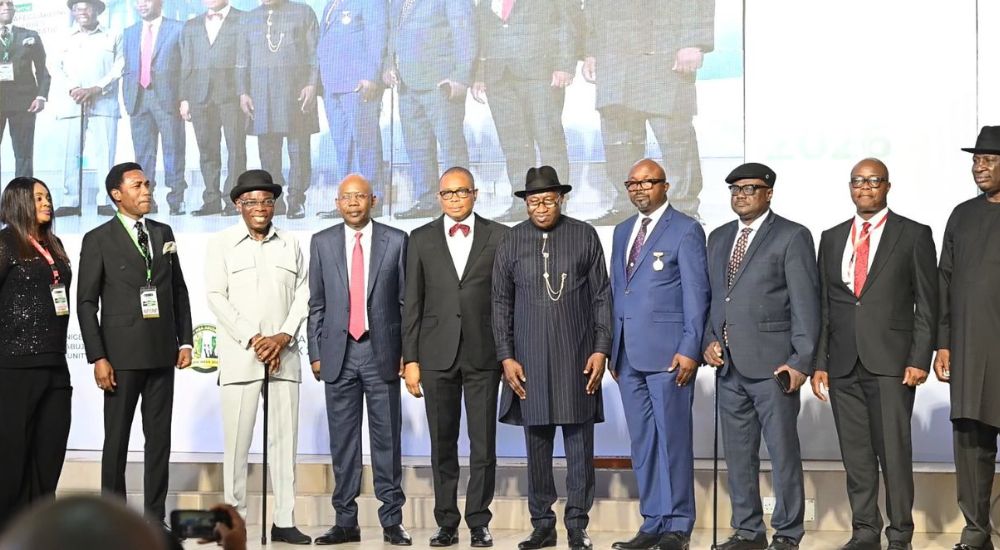
Also in attendance at the event were the Chief Judge of the High Court of the Federal Capital Territory, Justice Husseini Yusuf, who was represented, President of the African Bar Association, Ibrahim Maku, Chairman of NBA Abuja Branch (Unity Bar), Steve Emelieze, SAN, Chairman of the 2026 Law Week Planning Committee, Dr. Chinedu Obienu, and Onyeka Obiajulu, Secretary of the NBA Abuja Branch, among others.