
How 15-Year-Old Nearly Made It To National Assembly
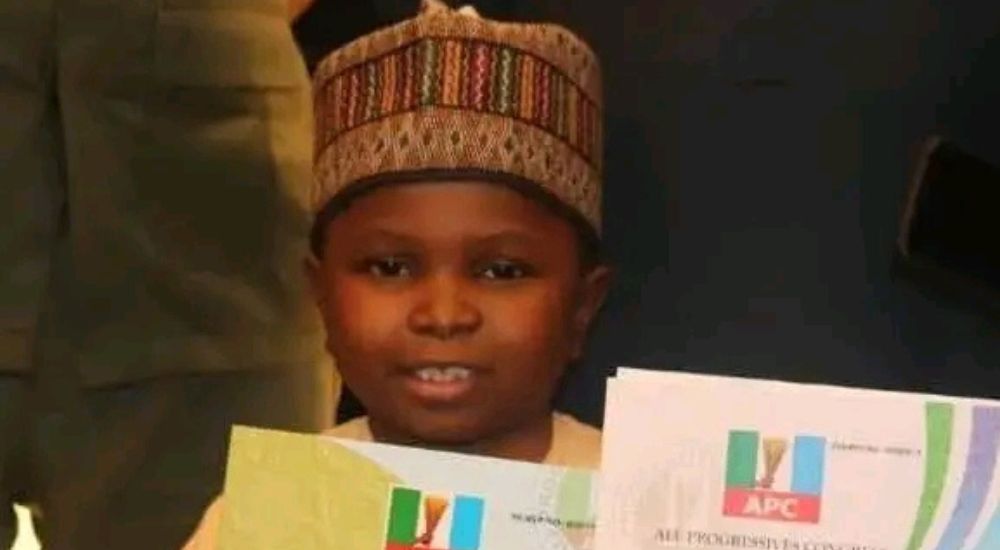
He went viral as an inspiration, a diminutive man from Zaria who dared to dream of a federal legislative seat.
Within days, the inspiration curdled into one of the most explosive age-falsification controversies in Nigerian political memory.
At the centre of it all: Mahmud Sadis Buba, a dwarfism-affected grassroots mobiliser from Sabon Gari, Zaria, who claimed to be 30 years old but whose own documents tell a markedly different story.
The Rise of “Abin Al-Ajabin Zazzau”
In Nigeria’s rough-and-tumble political arena, where age, influence, and wealth often shape public perception, the emergence of Mahmud Sadis Buba unsettled familiar assumptions.

Advertisement
The man who calls himself “Abin Al-Ajabin Zazzau” meaning “The Wonder of Zaria” shot to national attention in April 2026 after a video of his All Progressives Congress (APC) screening for the Sabon Gari Federal Constituency seat in the House of Representatives went viral across X, Facebook, and Instagram.
In the footage, he appeared before a panel of APC screening officials dressed in traditional attire, calmly answering questions about his age, educational background, and reasons for seeking office.
His physical appearance, specifically his small stature due to dwarfism and his remarkably youthful face triggered an immediate wave of public reaction.
Buba, who claimed to be 30 years old.
He hails from Sabon Gari in Zaria, reportedly holds a senior secondary school certificate, and according to him previously worked as a driver.
Advertisement
He is also the first of nine children and chairs the Tinubu–Uba Sani Agenda ’27 support group in Kaduna.
Former Kaduna Central Senator Shehu Sani amplified his story with a post on X that read: “Hon Mahmud Sadis Buba is 30 years old.
He bought his form to vie for the Reps seat in Zaria. A challenge to the youth.” His line during the screening noted that “It is not about me.
“It is from the people. People called me to serve them, and I will serve.”
This became one of the most quoted political statements on Nigerian social media that week.
The Documents That Changed Everything
Advertisement
The feel-good narrative collapsed almost as fast as it had risen. The most explosive issue became a fierce controversy over his actual age.
In his media chat, he said he was born on August 2, 1995; however, documents purportedly linked to him including an international passport, NIN slip, birth certificate, and school records suggest a 2010 birthdate, making him approximately 15 or 16 years old.

The smoking gun came from within his own family.
A family member reportedly publicly released what they described as his Nigerian passport issued in 2024, listing “SADISU MAHMUD BUBA” as born August 27, 2010, in Zaria to “clarify” the matter, referring to him as a “younger brother.”
The passport was issued in Sokoto on April 16, 2024, and is set to expire on April 15, 2029.
Beyond the passport, a former teacher came forward with direct testimony.
One Abdullahi Aliyu claimed to have taught Buba when he was in junior secondary school, adding that the politician is definitely 16 years old.
The allegations centre around discrepancies in documents said to belong to the aspirant, including his National Identification Number (NIN) slip and international passport, both of which reportedly contain conflicting date-of-birth details.
Disqualification and Withdrawal
The APC ultimately moved against him.
He was later disqualified over alleged age falsification after his international passport and National Identification Number (NIN) reportedly showed that he was born in 2010, contrary to claims that he was 30 years old.
Buba announced his withdrawal in a letter addressed to the Chairman of the APC in Kaduna State, which he also published on his verified Facebook page on Saturday.
In the letter, he said the decision, though difficult, became necessary following consultations with party stakeholders and reconciliation efforts within the APC.
“Please accept this letter as formal notification that I am withdrawing from the race for Sabon Gari Federal Constituency, House of Representatives, effective immediately,” the letter read.
“This was not an easy decision, but it was hastened by the reconciliation efforts initiated by stakeholders and leaders of our party.”
He stepped down and endorsed the incumbent member representing Sabon Gari Federal Constituency, Sadiq Ango Abdullahi, as the APC consensus candidate.
The Deeper Issue: Exploitation of a Minor?
The controversy raises serious questions that go beyond Buba himself.
His rapid rise triggered outrage, with critics accusing those behind his candidacy of exploiting a minor and falsifying age to meet the constitutional 25-year minimum for House of Representatives aspirants.
Nigeria’s 1999 Constitution (as amended) sets the minimum age for the House of Representatives at 30 years.
If documents placing Buba’s birth year at 2010 are authentic, he would be approximately 15 or 16 not merely below the constitutional threshold, but a minor under both Nigerian law and international child rights frameworks.
The question of who, if anyone, orchestrated or enabled his candidacy including how he reportedly passed the APC’s screening exercise still remains unanswered.
Efforts to obtain comments from Buba or his associates were unsuccessful.
A Mirror to Nigerian Politics
Public fascination with Buba reveals deeper truths about Nigeria’s political culture.
Much of the reaction focused less on his ideas and more on his appearance.
For some, he represented inspiration and courage. Yet his candidacy forced conversations around youth participation, disability inclusion, and whether Nigerian politics is truly open to unconventional entrants.
In the end, however, the story of Mahmud Sadis Buba is less about inclusion and more about a system that once again failed its most basic gatekeeping function. If a 15-year-old can scale a federal party’s screening process by claiming to be twice his age, the integrity questions facing the APC and INEC ahead of 2027 are far more serious than any single candidacy.