
Abia Civil Service Jobs Now Merit-Based, Not Political – Otti
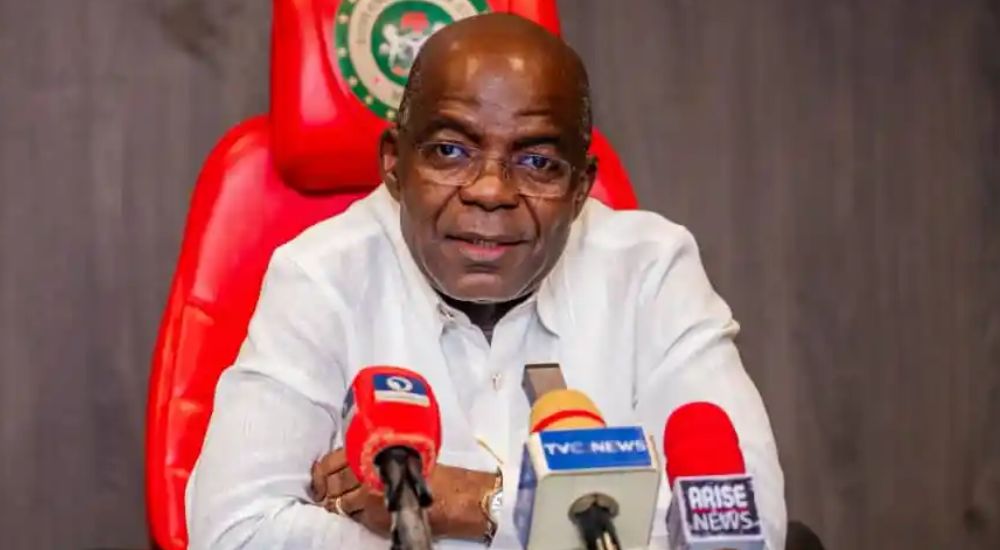
Abia State Governor, Dr. Alex Otti, has reaffirmed his administration’s commitment to good governance, meritocracy and competence in the appointment of public officials, saying positions in the state’s civil service are no longer reserved for political connections.
Governor Otti stated on Tuesday in Umuahia during an Executive Education Series hosted by the Abia State Leadership Academy, focused on “Strengthening Governance, Ethical Leadership and Public Service Delivery.
He said his administration had introduced a competitive process for the appointment of Permanent Secretaries, replacing the previous system where appointments could be influenced by personal relationships.
“In 2023, the state advertised vacant Permanent Secretary positions, attracting 425 qualified directors who underwent computer-based tests and oral interviews.
The top candidates were ranked based on merit, with the first candidate appointed Head of Service and others appointed Permanent Secretaries,” he explained.
The Governor also explained that the process was repeated following the retirement of the former Head of Service, with the candidate who emerged first in the second competitive exercise subsequently appointed Head of Service.
Advertisement
Otti also highlighted the appointment of Benson, an indigene of Edo state and the SouthSouth, as Head of Service, describing it as evidence of his administration’s commitment to merit and inclusiveness.
He noted that Benson had served in Abia for several years, rising through the civil service after gaining employment following his National Youth Service Corps programme.
The Governor maintained that residency and contribution to the development of Abia should be given consideration, stressing that people who live and work in the state should be regarded as part of its community.
He further called for a governance system built around competence, pedigree and integrity, saying the quality of people appointed into public offices is critical to achieving sustainable development.
Earlier on, the guest speaker, Mr. Osita Chidioka, former minister of Aviation and former Corp Marshal of the federal road safety corp, drawing lessons from governance systems in China, Britain, Singapore, Rwanda and Nigeria, stressed that no government can achieve meaningful development without the administrative capacity to translate policies and visions into tangible results.
Advertisement
He said the experience of China demonstrated the importance of meritocracy in public administration, noting that the country had, centuries ago, developed systems for selecting public officials based on demonstrated competence.
According to him, “The exercise of public authority requires demonstrated competence, and government is too consequential a business to be started casually.”
He also used China’s rapid development and industrial execution to illustrate the importance of a bureaucracy capable of delivering government projects efficiently.
“Vision announced from a podium travels only as far as the machinery is able to deliver it, emphasising that a government’s development agenda would remain largely theoretical if its public institutions lacked the capacity to execute it,” he said.
Chidioka identified Singapore as another important example, highlighting the country’s deliberate investment in human capital, strategic planning, performance management and integrity in public service.
He noted that Singapore’s success was not simply because its people were more intelligent than others, but because its institutions were structured to execute policies effectively.
Advertisement
“Policy without execution just becomes a paper,” he stated.
Turning to Nigeria, he observed that the country had previously demonstrated considerable capacity to develop and implement national development plans, citing infrastructure projects executed during earlier administrations.
He, however, expressed concern that successive development visions had often failed to achieve their intended outcomes because of weak institutional capacity and poor execution.
He therefore urged Abia State to ensure that its development agenda is supported by a public service capable of sustaining and implementing policies beyond individual administrations.
Chidioka also stressed the need to strengthen Nigeria’s public institutions rather than relying excessively on contractors and consultants.
According to him, the weakening of technical capacity within the public service has resulted in governments increasingly outsourcing functions that should ordinarily be performed by competent government professionals.
“Behind every visible achievement of government lies an invisible chain of competence,” he said.
He further challenged political appointees to understand that their responsibility extends beyond managing ministries during their tenure. Rather, they should create systems, procedures and standards that can survive their departure from office.
On public expenditure, he argued against treating recurrent expenditure as inherently opposed to development.
He explained that recurrent expenditure consists of both personnel costs and overhead costs, with the latter providing the tools required for public servants to perform their duties.
“Overhead is the operating system of government,” he said, stressing that public servants need functional offices, electricity, transportation, internet access, computers and other resources to effectively deliver services.
Using examples from policing, education and healthcare, he warned that governments could construct impressive infrastructure without creating the capacity required to make such infrastructure functional.
“There is infrastructure we can photograph, and there is infrastructure that makes the photographed infrastructure actually work,” he said.
He also emphasised the importance of technology in improving government efficiency. He recounted his experience introducing digital communication systems and connectivity during his time in public service, noting that technology could significantly reduce bureaucratic delays and improve service delivery.
He urged political appointees to look beyond their individual ministries and leverage existing government resources and systems to improve services for citizens.
According to him, government must be viewed from the perspective of the citizen rather than through isolated ministries and agencies.
He also highlighted what he described as the “two calendars of government” the relatively short tenure of political appointees and the much longer careers of civil servants.
While political appointees may have only four years to demonstrate results, career civil servants may remain within the system for decades.
He said this difference creates a potential misalignment that must be addressed through deliberate collaboration.
“The greatest task before every political appointee is to create that alignment,” he stated.
The former minister warned that without such alignment, reforms would remain temporary and dependent on the individuals who introduced them.
He explained that a new commissioner could introduce a reform, achieve progress during his tenure and leave, only for the succeeding administration to abandon the initiative and start afresh.
“That is not institutional reform. It is a succession of personal projects,” he said.
He therefore called on political appointees to institutionalise their reforms by incorporating effective practices into government rules, procedures, performance systems and conditions of service.
Reflecting on his experience with the Federal Road Safety Corps, he explained how performance measurement, computer-based examinations, merit-based promotion and quality management systems were incorporated into the organisation’s formal conditions of service.
He said such institutionalisation ensured that subsequent leaders could not easily discard established standards.
Chidioka also highlighted the importance of developing a pipeline of competent future leaders, commending the Abia Leadership Academy for its efforts to identify and prepare young people across the state’s 17 local government areas for future leadership responsibilities.
He, however, cautioned that the success of the academy should ultimately be measured by the quality of leaders and institutions it produces over time.
“Judge administration by what survives and performs after its founders have moved on, not by the eloquence of its founding purpose,” he said.
He encouraged the academy to become a platform for sharing successful practices across ministries and among emerging leaders, arguing that such knowledge exchange would help create a public service anchored on shared values and institutional memory.
The guest speaker also urged current political appointees to see their responsibility as larger than their individual tenure, noting that every governor, commissioner, special adviser and permanent secretary would eventually leave office.
“Every commissioner in this room will eventually leave office. Every special adviser will leave. Every permanent secretary will eventually retire. That is not a weakness of government. It is simply the nature of government,” he said.
He called on the administration to build not only physical infrastructure but also institutional and human capital capable of sustaining development.
He said the ultimate goal should be to create a system where public services function without requiring constant intervention from the governor or commissioner.
“Build one in which the commissioner does not have to make the telephone call before something happens, and the governor does not have to intervene personally before the system works,” he said.
The speaker further urged Abia to preserve the progress being recorded in the state by embedding good governance practices into the DNA of its institutions.
He noted that the state had experienced periods of strong promise followed by declining performance in previous administrations and stressed the need to ensure that current reforms are sustained beyond individual political leaders.
Concluding his remarks, he said the central lesson from the experiences of China, Britain, Singapore, Rwanda and Nigeria was clear: “There is no high capacity state without high-capacity people.”
He added that the state has no hands except those of its officials, no institutional memory except the records they keep, and no capacity to execute decisions except the capacity of its people to convert those decisions into results.
He urged participants at the Executive Education Series to ensure that the current governance reforms in Abia become institutional rather than personality driven, stressing that the ultimate measure of success would be whether the systems created today continue to deliver good governance long after their architects have left office.
The Whistler reports that the Executive Education Series forms part of the Abia Leadership Academy’s broader efforts to strengthen leadership capacity, promote ethical governance and prepare a new generation of public servants and leaders across the state.