
Artemis II Crew Returns To Earth After Historic Moon Mission
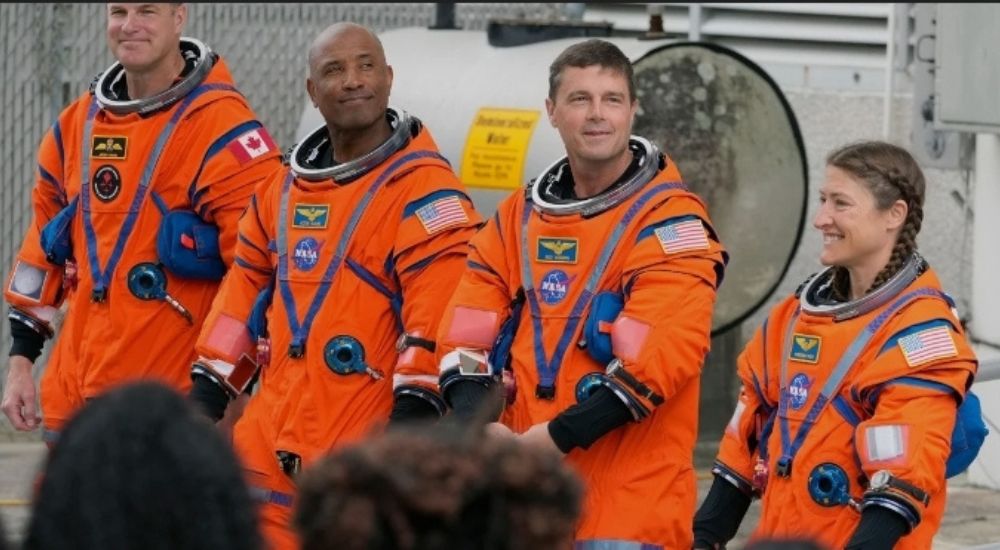
NASA’s Artemis II astronauts have safely returned to Earth after completing a 10-day mission around the Moon, marking the first crewed voyage beyond low-Earth orbit in more than five decades and a major step forward in the United States’ return-to-the-Moon program.
The Orion spacecraft, Integrity, splashed down in the Pacific Ocean at 8:07 p.m. EDT on Friday, April 10, off the coast of San Diego, bringing to an end a mission that covered approximately 694,000 miles and included a close flyby of the Moon’s far side.
The landing, which NASA described as precise and stable, followed a high speed re-entry through Earth’s atmosphere at about 25,000 mph, during which the spacecraft endured extreme temperatures before deploying parachutes for its final descent.
The four-member international crew comprised NASA astronauts Reid Wiseman (Commander), Victor Glover, and Christina Koch, alongside Canadian Space Agency astronaut Jeremy Hansen.
Their mission was designed as a critical test flight for the Orion spacecraft and the broader Artemis program, which aims to return humans to the lunar surface later this decade.
Advertisement
Recovery operations began minutes after splashdown, with U.S. Navy vessels and NASA teams moving in to secure the capsule.
The astronauts were then airlifted by helicopter to the USS John P. Murtha, where medical teams conducted initial health checks. NASA confirmed all four crew members were in good condition following recovery operations.
Flight Director Rick Henfling said in a post-landing briefing that the astronauts were “happy and healthy” and had successfully completed all mission objectives.
He added that the crew would travel later to NASA’s Johnson Space Center in Houston for further debriefings, data analysis, and reunions with their families.
Throughout the mission, the Artemis II crew tested key systems aboard the Orion spacecraft, including its life support systems, heat shield performance, navigation systems, and deep space communication capabilities.
Advertisement
NASA officials said the data gathered would be crucial in preparing for future crewed lunar landings, particularly Artemis III, which is expected to put astronauts back on the Moon for the first time since 1972.
NASA also said Artemis II demonstrated the spacecraft’s ability to safely support humans in deep space for extended periods, with the mission serving as the farthest distance humans have traveled from Earth since the Apollo era.
Shortly after recovery, NASA released images showing the astronauts aboard recovery vessels, smiling and interacting with personnel as they underwent post-flight medical evaluations.
Additional imagery and video from the mission are expected to be published in the coming days through NASA’s official channels.
Public reaction to the mission has been broadly positive, with updates and images circulating widely online as the successful splashdown marked another milestone in renewed global interest in lunar exploration.
As the crew begins their return to normal gravity conditions and prepares for debriefing in Houston, NASA officials have described the mission as a significant validation of the Artemis program’s readiness for future lunar landing operations and long-term human exploration beyond Earth orbit.
Advertisement