
A Consensus Foretold: Ogun’s Collegiate Moment
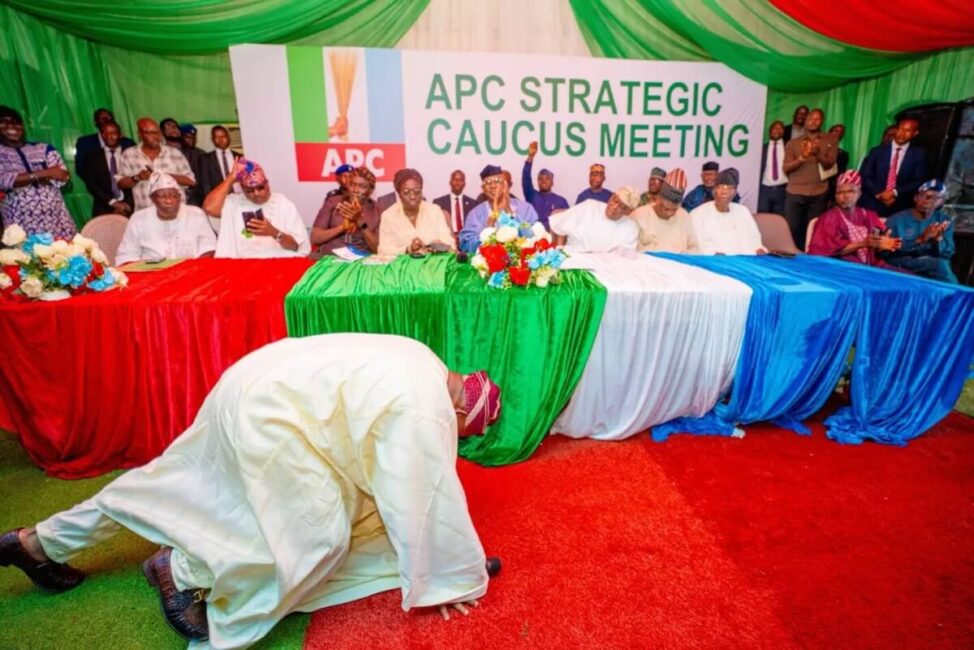
On Monday, 13 April 2026, Ogun State’s political theatre staged a scene that felt less like a contest and more like a reconciliation. At the APC Secretariat in Abeokuta, under the watchful gaze of history, Governor Dapo Abiodun declared Senator Solomon Olamilekan Adeola – Yayi – as the party’s governorship candidate.
The announcement was not a thunderclap but a settling of dust. In attendance were all living elected governors of Ogun: Aremo Segun Osoba, Otunba Gbenga Daniel, Senator Ibikunle Amosun, and the incumbent himself, Prince Dapo Abiodun.
Their presence lent gravitas, as though the state’s political lineage had gathered to hand forward the baton. Party elders, senators, and aspirants filled the hall, their faces registering not shock but recognition.
Governor Abiodun’s words were measured, almost conciliatory: “I have consulted with other aspirants from Ogun West. This decision is aimed at harmonising the party, devoid of anti‑party acrimony, as we prepare towards the 2027 general election.”
It was a riposte to the murmurs of rivalry, a reminder that consensus is not exclusion but preservation.
Consensus in Nigerian politics is paradoxical. It appears undemocratic – a decision made by elders rather than delegates – yet it often produces outcomes that resonate with popular sentiment. Ogun’s collegiate arrangement embodies this paradox. It tempers ambition with consultation, insisting that unity is preferable to fracture.
Advertisement
The presence of Osoba, Daniel, Amosun, and Abiodun together was symbolic: men who once contested fiercely now stood shoulder to shoulder, endorsing a successor. In a polity often defined by rivalry, such unanimity is rare. The collegiate system, far from silencing ambition, reframed it as collective sacrifice.
Adeola’s trajectory explains the consensus. His career, from Lagos politics to representing Ogun West in the Senate, is a scroll of deeds: legislative advocacy, infrastructural push, empowerment initiatives. These are not abstractions but footprints – evidence of a man who has walked with his people. In literary terms, his record is a palimpsest, inscribed with the aspirations of those who see in him a mirror of their own striving. The collegiate arrangement did not conjure him; it merely gave form to what was already present: the chorus of Ogun’s citizens, who had sung his name in rallies and whispered it in markets.
Consensus politics has a long lineage in Nigeria. In the Second Republic, parties often sought to avoid bruising primaries by rallying around a single candidate. The leading parties, National Party of Nigeria (NPN) and the Unity Party of Nigeria (UPN), for instance, used consensus to balance regional interests, ensuring that ambition did not fracture the party’s fragile coalition.
Closer to home, Chief Obafemi Awolowo embodied the Yoruba tradition of collegiate leadership. In the Action Group of the First Republic, Awolowo’s emergence was not merely the product of personal ambition but of collective recognition. Elders and party stalwarts rallied around him, believing his vision for free education and social welfare was the embodiment of Yoruba aspirations. His leadership was framed as destiny, not imposition – a consensus that gave the West stability in turbulent times.
Consensus is not alien to Yoruba political culture. In traditional councils, elders often mediate disputes, urging rivals to sheathe swords for the sake of communal harmony. The Yoruba proverb – Agba kii wa loja, ki ori omo tuntun wo (“Where elders are present, a child’s head will not go askew”) – captures this ethos. The Abeokuta meeting echoed this tradition. Elders and governors gathered, not to impose but to harmonise, ensuring that Ogun’s political head would not go askew. Adeola’s emergence was thus not only a party decision but a cultural affirmation: the elders had spoken, and the people’s chorus had been validated.
Advertisement
Consensus is hollow if it does not resonate with the people. But here, the declaration crystallised popular will. Adeola’s accessibility, his responsiveness, his rootedness in Ogun West – these have made him shorthand for representation. Governor Abiodun’s announcement was less imposition than recognition. The people’s chorus had already chosen; the party merely formalised it.
Yet consensus requires sacrifice. Other aspirants – men and women of ambition – must now confront the reality that the party has spoken. To resist is natural; to fracture is tempting. But the higher call is to unity. To sheathe the sword is not to admit defeat but to embrace destiny. It is to recognise that politics is not merely about personal ambition but about collective progress. In Ogun’s grand narrative, Adeola’s emergence is not the diminishment of others but the elevation of the state’s future.
The irony is palpable: a collegiate system, seemingly elitist, ratifies what many in Ogun’s grassroots already believed – that Yayi’s time had come. The paradox is instructive. Politics here is not about the arithmetic of delegates alone; it is about the whisper of destiny aligning with collective will. Ogun has chosen to harmonise ambition with destiny, to turn rivalry into chorus, to make of politics not a battlefield but a covenant. It’s after all a state of many firsts.
As the sun set on April 13, the declaration reverberated beyond Abeokuta. Ogun became the first state and APC the first party to deliver on a candidate for the 2027 general election. It spoke to a future where Ogun’s politics is not defined by endless strife but by purposeful unity. Consensus foretold has become consensus fulfilled. The swords are to be sheathed, the banners raised, and the march begun. In the presence of all living governors, Ogun APC chose unity over rivalry, and in Adeola, found a candidate whose record and resonance made him the people’s choice.
-Somorin, former Chief Press Secretary to Gov. Abiodun, writes from Abeokuta
Advertisement