
Deserted Homes, Burnt Buildings: Inside Enugu Community After Army-IPOB Gun Battle
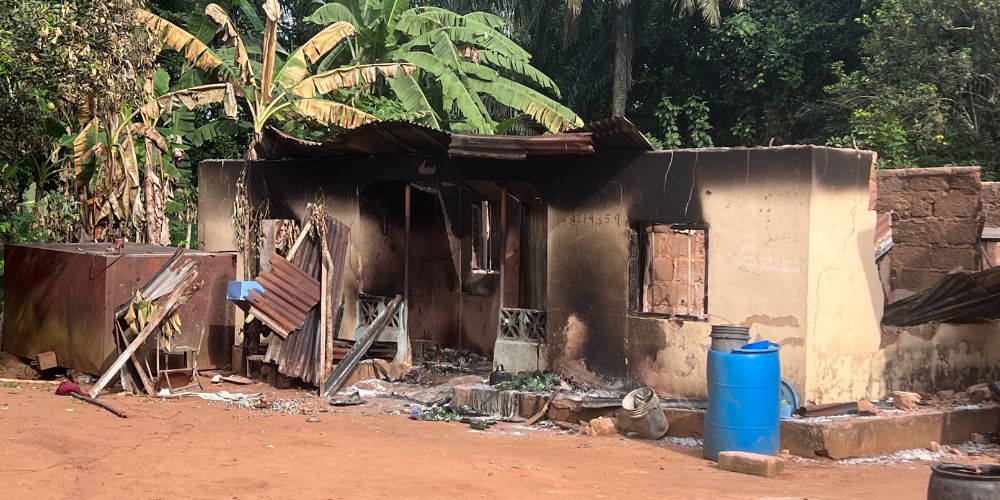
A disturbing silence now hangs over Ukpata, Ezema Imezi Owa, a quiet agrarian community in Ezema Local Government Area of Enugu State, after a violent confrontation between personnel of the Nigerian Army and suspected members of the outlawed Indigenous People of Biafra (IPOB) and its armed wing, the Eastern Security Network (ESN).
What was once a sleepy village dotted with modest homes and narrow pathways has become a community gripped by fear, uncertainty and displacement.
The clash, which occurred on May 6, reportedly left several buildings destroyed, triggered panic among residents and forced many families to abandon their homes.
When THE WHISTLER visited the community two days after the incident, the atmosphere was tense and unusually quiet.
The journey from the Enugu-Onitsha expressway into the heart of Ukpata, Ezema Imezi Owa, revealed a settlement seemingly frozen by fear.
Advertisement
An 11-minute motorcycle ride along a lonely, narrow road led to rows of deserted compounds. Homes were locked, streets empty and movement almost nonexistent.
The few residents seen along the route were from neighbouring villages, while several commercial motorcyclists declined trips into the community, describing the area as unsafe. Because many locals had already branded Ukpata, Ezema Imezi Owa a danger zone when this medium visited.

At the centre of the destruction stood three visibly damaged buildings inside an unfenced compound. One bungalow had its windows completely shattered, another was partially burnt with visible fire damage, while a third building had its roof badly destroyed after being engulfed by flames.
Advertisement
Broken beer bottles littered the surroundings, while scorch marks and debris painted a grim picture of the violence that unfolded days earlier.
Residents who spoke with THE WHISTLER did so cautiously, fearful of possible repercussions.
One motorcyclist, who asked not to be named for security reasons, said he stayed away from the community after hearing gunshots during the incident.
“I was outside the village working with my motorcycle when I heard what happened,” he said.
“The incident happened in the afternoon. I refused to return home until Friday because people were afraid. As you can see, everywhere is empty and nobody wants to speak openly about it.”
Several indigenes living outside the community also confirmed that suspected IPOB operatives occasionally move in and out of the area.
Advertisement
According to one source, whose brother’s house was reportedly affected during the operation, armed men linked to the separatist group do not permanently stay in the community.
“They come and go,” the source said, adding that his brother, who lives in Port Harcourt, lost his building during the violence.
Community leaders have, however, remained cautious in their response.
The President General of Ukpata, Ezema Imezi Owa, Remigius Ozoanya, described the incident as serious but said investigations were still ongoing.
“We are already handling the matter and have informed the Local Government Chairman,” he told THE WHISTLER in a telephone conversation.
“At this stage, we cannot speak based on assumptions or hearsay. We are planning to visit the affected area next week to gather proper information.”

He also noted that no official report of casualties among residents had been received.
While uncertainty continues to surround the full extent of the damage, the Nigerian Army insists the operation was targeted at dismantling criminal networks linked to IPOB and ESN activities in the area.
In a statement signed by the Acting Deputy Director, Army Public Relations, 82 Division, Lt.-Col. Olabisi Ayeni, the Army described the mission as an intelligence-led operation aimed at neutralising armed elements and their collaborators.
According to the statement, troops came under attack while advancing into the community, leading to injuries to three military personnel.
“Despite the attack, troops maintained operational dominance, foiled the attack and secured the general area,” the statement read.
The Army said an explosion caused by Improvised Explosive Devices allegedly stored inside a building used by the attackers triggered the fire that destroyed parts of the community.
Security operatives also claimed to have recovered additional explosives, improvised hand grenades and a shrine allegedly used for criminal and ritual activities.
One suspected collaborator was reportedly arrested and handed over to the police for further investigation.
The military further urged residents not to harbour criminal elements, assuring that operations in the South-East would continue in a bid to restore peace and stability.
But beyond official statements and security briefings lies a traumatised community struggling to recover from the aftermath of violence.
For many residents of Imezi Owa, the fear is no longer just about what happened on May 6, but about what may happen next.