
Mene Ogidi Killing Exposes Escalating Illegal Firearms Proliferation In Delta
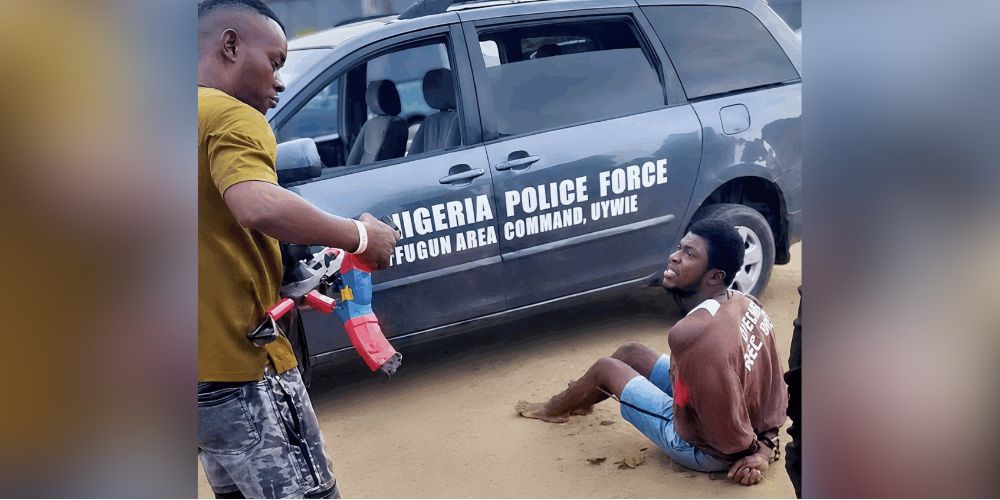
The killing of Mene Ogidi by a police officer on April 26, not only reignited discussions on extrajudicial killings but also highlighted the growing access to and use of firearms in Delta State.
The killing, captured in a viral video, according to the police, followed Ogidi’s attempt to deliver a Beretta pistol with four live ammunition concealed in a parcel through a commercial motor park in Effurun.
With a Magazine rifle pointed at him, Ogidi pledged to disclose the individuals involved in the transition of the weapon, however, his death raised suspicion of police complicity in shielding the syndicate.
Such allegations also revisited discussions about police involvement in the proliferation of Small Arms and Light Weapons (SALW) across the country and a deepening mistrust between the public and the Nigeria Police Force.
In Delta State, the bold transition of firearms by criminals incited a police-led directive for logistic companies to search parcels before accepting them, and this led to Ogidi’s fall.
What Data Say
Advertisement
His weapon, recovered by the police, is one of 28 Beretta pistols, some of which were fabricated and seized from suspected criminals in the state between April 2025 and April 2026.
THE WHISTLER evaluated 72 press releases by the Delta Police Command within the period, specifically those addressing weapon recoveries and arrests to contextualise the situation.
The outcome revealed the recovery of no fewer than 181 weapons from suspected kidnappers, armed robbers, cult members, gunrunners, fabricators and travellers.
The analysis discovered a proliferation of locally made guns, at least 49, indicating an upsurge in the patronage of gun fabricators, many of whom are within the state, and neighbouring Onitsha, in Anambra.
A breakdown further showed the recovery of 14 english double barrel guns, 12 single-barreled guns and 30 pump actions, mainly confiscated from at least 41 arrested kidnap suspects.
Advertisement
The police command also seized 25 AK-47 rifles; 10 AK-47 magazines; three (3) K-2 Rifles; three (3) K-2 Magazines and two (2) cut-size pistols.
Not to mention the seizures of two (2) Dane guns, and each of an FNC rifle, a submachine gun and a revolver gun within the year in view.
These records by the police could be conservative for security purposes, however, THE WHISTLER identified a disturbing number of armed robbery cases, with not less than 119 suspects arrested.
All had a weapon upon arrest, and in separate cases, investigation led to more firearm recoveries from their homes and hideouts in distant bushes.
Many of them were also arrested while driving on local and major highways with firearms concealed in vehicles.
Cultist activities were also on the rise. At least 92 suspected cult members were arrested, with at least 13 axes seized from the suspects.
Advertisement
THE WHISTLER discovered an increased activity of cross-border criminal operations, particularly in cases of suspects perpetrating crimes in Delta, while residing in Anambra, Edo, Imo and Rivers.
Underlying Factors
Owner of Beacon Consulting, a risk assessment company, Dr Kabir Adamu describes the proliferation of SALW as a combination of security failure and a symptom of deep governance deficits.
He argued that the primary driver of Nigeria’s security crisis transforms what ordinarily are local disputes into lethal sieges.
“The widespread availability of these weapons fuels a cycle of violence where bandits, terrorists, and militias operate with lethal efficiency,” Adamu said.
He highlighted underlying drivers including porous borders and smuggling, particularly with unstable Sahelian states, posing as major transit routes where weapons are easily trafficked.
Security personnel stretched thin in conflict zones, combined with corruption according to Adamu, contribute to weak armoury management that allows weapons to leak from state stockpiles directly into criminal hands.
“As the NCCSALW itself has stated, the 1959 Firearms Act is ‘completely obsolete’, leaving authorities without the legal framework to respond to modern trafficking tactics for decades,” he noted
Recommendations
In response to localising intelligence gathering and intervention, the National Centre for the Control of Small Arms and Light Weapons (NCCSALW) established zonal offices in hotspot regions including North-East, North-Central and South-West.
However, with the growing proliferation of SALW in the South-East and South-South regions, it remains uncertain when the Centre establishes a presence in the South-East and South-South.
Following the recent incident in Delta, the Nigeria Police Force had directed all Commissioners of Police to undertake a comprehensive audit of arms and ammunition within their respective commands.
In addition, Adamu recommended an urgent digital tracking across all state-owned armouries across enforcement agencies to reduce the diversion of official weapons to criminals.
However, to break the cycle of violence, Adamu said, the country needs a multi-dimensional strategy that goes beyond “mopping up” weapons.
The security expert further asked the NCCSALW to fast-track the creation of a national register for local gunmakers.
“Rather than arresting them, authorities should license, train, and integrate skilled artisans, transforming ‘illegal fabricators’ into a regulated local defence industry.
“Enforcement agencies must shift from isolated patrols to an intelligence-led “soft target” strategy at borders.
“This involves deploying scanners at legal entry points and creating a fusion unit to map the trans-Saharan smuggling routes.
“The NCCSALW must enforce the new 2024 Act rigorously. Security forces need to move past ‘recover and destroy’ protocols to ensure high-profile convictions for arms traffickers to deter future smuggling,” he noted.