
Osun: N43bn Spent, 29 Killed As Vote Buying, Security Soar Election Costs—Investigation
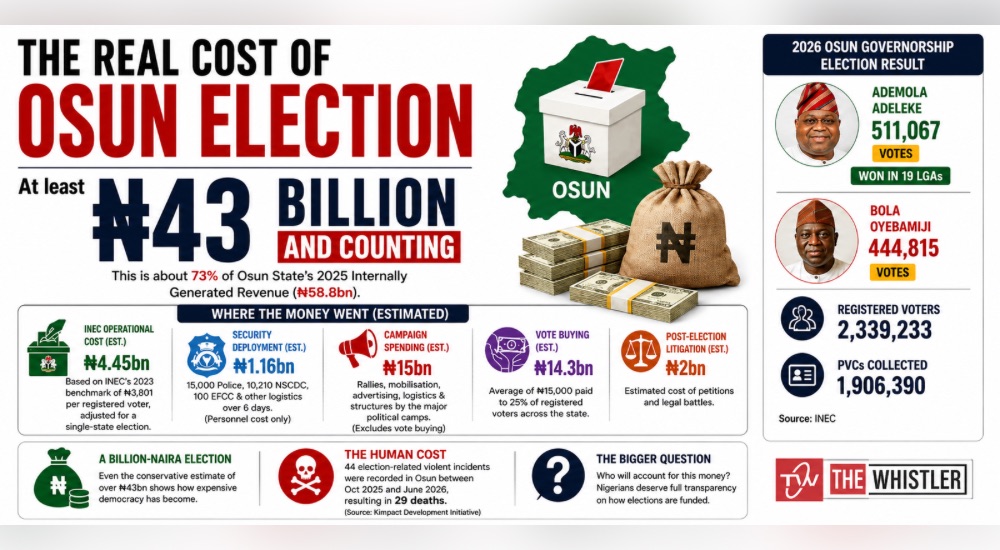
…Political Spending Exceeds Half Of State’s 2025 IGR
Governor Ademola Adeleke’s re-election as Osun State governor came at a cost—in cash, blood and public trust—that a THE WHISTLER investigation shows far outweighs both the state’s resources and the spending limits set by Nigeria’s electoral laws.
Adeleke was declared winner at 7:24 a.m. on Sunday, August 16, by Prof. Joshua Ogunwole in Osogbo, polling 511,067 votes to defeat his closest challenger, Bola Oyebamiji of the All Progressives Congress (APC), who scored 444,815 votes. Adeleke won 19 of the state’s 30 local government areas.
The crowd cheered and the governor danced. But in Ilobu, Irepodun Local Government Area, the family of 14-year-old Ezekiel Olapade, who was shot dead outside the LGA secretariat three days earlier, was still mourning.
Ezekiel had nothing to do with either candidate. He was not a party agent or a thug. He was simply a child who happened to be near the wrong place at the wrong time in an election that cost the country far more than the result could ever return.
Experts who spoke to THE WHISTLER said the scale of the estimated political expenditure raises questions that go beyond the Osun election itself.
Advertisement
They include voters who accepted N15,000 from party agents and were left with nothing more than a receipt they cannot cash; families of the at least 29 people killed in election-related violence between October 2025 and August 15; and the 57 per cent of registered voters who collected their Permanent Voter Cards but, for whatever reason, did not go out to vote.
A conflict analyst, Afeez Balogun, who reviewed the Osun election violence data, told THE WHISTLER that establishing why security failed to prevent the bloodshed would require a post-election assessment comparing where personnel were deployed with where incidents occurred.
“You cannot measure the effectiveness of election security simply by counting personnel,” the analyst said. “You have to compare deployment against incidents, response time, arrests and prosecutions.”
INEC Financial Bill
INEC committed a proposed N171bn for its 2026 electoral operations nationwide, covering off-cycle elections, including Osun’s, routine administrative costs and preparations for the 2027 general election.
Advertisement
The budget breaks down into N109bn for personnel, N18.7bn for overhead and N42.63bn for specific election activities. Applying the commission’s 2023 benchmark of N3,801 per registered voter to Osun’s 1,906,390 eligible voters puts the operational cost of the Osun election at roughly N7.25bn.
The commission mobilised 30,000 NYSC members as ad hoc staff across 3,763 polling units, using 97 Super Registration Area Centres and 105 standard Registration Area Centres. The corps members earned between N25,000 and N40,000 each, putting the ad hoc wage bill at between N750m and N1.2bn.
INEC also reprinted ballot papers in Abuja after a last-minute court order forced the inclusion of an additional party on the ballot, adding logistics costs that have not been publicly disclosed.
Security Operations
No fewer than 15,000 police officers were deployed to Osun, alongside 10,210 personnel from the NSCDC and about 100 EFCC operatives sent specifically to check vote buying.
The NSCDC Commandant-General had ordered reinforcements drawn from 10 neighbouring state commands, with about 1,000 personnel each from Oyo, Lagos, Kwara, Kogi and the FCT, among others.
Advertisement
Armoured Personnel Carriers were also positioned at INEC headquarters in Osogbo, while helicopters and drones were deployed for aerial surveillance. INEC’s pre-election risk assessment had identified 385 security flashpoints and 200 difficult-to-access locations.
Based on credible police and NSCDC sources on alleged payments of N8,000 per police officer and N6,000 per NSCDC officer per day over six days, THE WHISTLER’s analysis showed that the personnel allowance bill alone was about N1.1bn. This excluded Armoured Personnel Carriers, aviation assets and army personnel deployed to INEC’s Osogbo headquarters, which were borne by the defence budget.
Vote-Buying Economy
No fewer than 100 EFCC operatives deployed specifically to check vote buying announced a single arrest, despite video evidence and reports from journalists and election observers documenting widespread cases of vote buying across the state.
Reports also indicated that, in the lead-up to the election, Edo State Governor Monday Okpebholo urged a crowd at one rally to collect money from the Accord Party but vote APC, without any response from the anti-graft agency.
Findings revealed that both the APC and Accord Party allegedly distributed cash to voters in the days before August 15.
The rate per vote ranged between N10,000 and N20,000, depending on the party and location, according to video evidence reviewed by THE WHISTLER.
In Ila, Accord agents were reportedly paying N20,000 and APC agents N15,000. In Ife, the APC was offering N15,000.
In Ikire, the APC candidate’s hometown, both parties were reportedly paying between N10,000 and N20,000. In Irewole, a voter claimed Accord paid N2,500 while APC offered N20,000.
The buying began on Monday, August 10, five days before election day, earlier than in any previous Osun election. Some voters were not paid in cash; agents reportedly collected bank account numbers a week before the election, promising transfers after voting.
THE WHISTLER’s calculation of the total vote-buying bill, based on documented rates, showed that 25 per cent of eligible voters received payment from at least one major party, producing a figure of about N14.3bn. At a broader reach of 40 per cent and higher reported rates, the figure could rise to N30.5bn.
Either estimate exceeded the government’s legal spending ceiling of N3bn per candidate for an entire campaign.
Yiaga Africa, which deployed 300 observers across all 30 local government areas using its PRVT methodology, confirmed that the official results fell within its independently estimated range.
“The consistency of the results speaks specifically to the accuracy of the tabulation of polling-unit results,” Yiaga said in its final statement.
“Widespread reports of vote buying and voter inducement raise serious concerns about the integrity of voter choice.”
Money Politics Question
The Electoral Act 2026 permits each governorship candidate to spend a maximum of N3bn on their campaign.
The EFCC Chairman, Ola Olukoyede, had said in June 2026 that governorship candidates across Nigeria were spending between N20bn and N30bn per electoral cycle. He made the remark publicly at a symposium, not specifically about Osun.
The APC candidate, Bola Oyebamiji, had donated N10m in cash to the Igbonna Market Cooperative during an endorsement rally in Osogbo in July, the smallest verifiable campaign expenditure on record.
The campaign involved rally logistics, party structure payments across 332 wards and 30 LGAs, and the mobilisation of political figures, including sitting governors from Edo and Kogi states.
Nigerian Afrobeats star Davido, the governor’s nephew, campaigned for his uncle, though the Accord Party did not pay him for his appearances.
Based on available documents, statements and reports, THE WHISTLER’s findings showed that the combined campaign spending by the two main parties, excluding vote buying, was about N15bn.
When added to the findings on the cost of alleged vote buying, the total political spending on the election exceeded N29bn, which is more than half of the N58.8bn Osun generated from IGR in 2025.
The governor of Osun State controls a budget funded by federal allocations and state IGR. Based on Osun’s 2025 IGR and estimated annual FAAC allocations, any governor who occupies the office for four years will oversee combined revenue running into hundreds of billions of naira.
The EFCC chairman had said politicians who spend N20bn to N30bn to win an election do not absorb that loss quietly. They recover it through the same treasury they were elected to steward.
An economist, Victor Emeka, who spoke to THE WHISTLER, said the issue was not merely the size of the spending but the incentives it creates.
“When the private cost of obtaining political office becomes extremely high, the risk is that public office becomes an investment rather than a responsibility,” the economist said.
Human Cost
At least 29 people died in election-related violence in Osun State between October 2025 and August 15, according to the Kimpact Development Initiative, which documented 73 violent incidents. The Centre for Journalism Innovation and Development recorded 34 incidents and 18 deaths since May 2026 alone.
The Nigeria Police Force separately classified at least 30 killings as politically motivated. The two major parties claimed a combined 18 of their members had been killed, though the figure has not been independently verified.
The youngest victim on record was Ezekiel, who was shot at the Irepodun LGA Secretariat in the final days of the campaign. His father told journalists that police officers stationed nearby did not intervene. No suspect has been publicly named and no arrest has been announced.
Violence was concentrated in Ilesa, Esa-Oke, Osogbo and Ede South. In Ilesa alone, at least eight people were reported killed between the Monday night and the Friday before election day.
Fear of further attacks was cited by community members as a reason people stayed home on election day, which would help explain why only 43 per cent of eligible voters turned out despite record registration numbers.
The 25,310 security personnel deployed were briefed, armed and positioned across the state. Yet, despite the deployment, violence occurred, as corroborated by the police, while vote buying allegedly happened in front of officers specifically sent to stop it.
The Electoral Act 2026 mandates, under Section 93, that campaign spending be certified and published for public inspection.