
Analysis 2027: Will Tinubu Pull Obasanjo’s 2003 Trick On Adeleke?
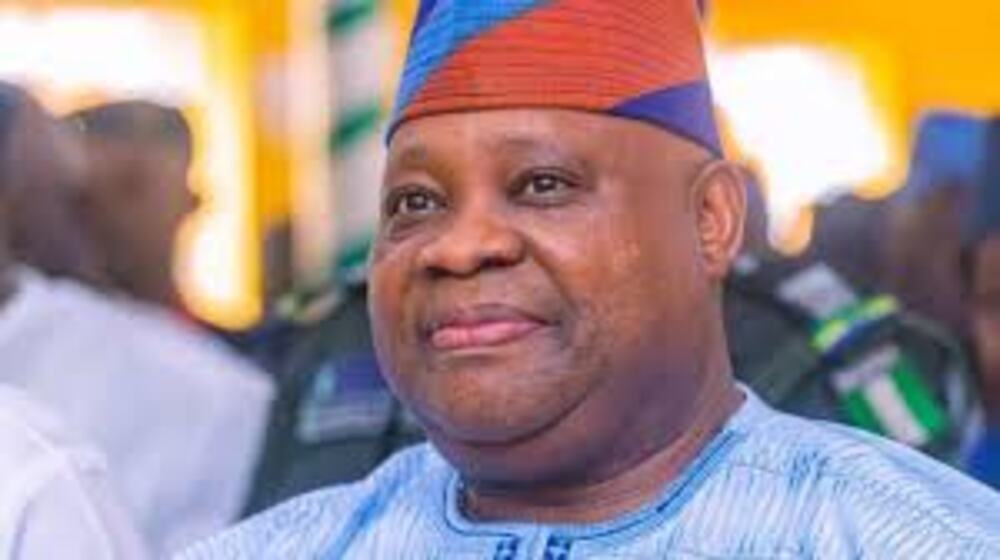
The just-concluded governorship election in Osun State has left political actors and stakeholders with lessons that will likely shape the direction of voting in the 2027 general election. The first major lesson from the Osun poll is the apparent demystification of the proverbial “federal might,” which has long been regarded as a strong factor in determining the outcomes of many state and federal elections.
Nothing demonstrates this more clearly than the victory of incumbent Governor Ademola Adeleke, who contested on the platform of the Accord Party, an otherwise fringe political platform. Adeleke found himself in Accord because there was nowhere else for him to turn after the Peoples Democratic Party (PDP), on whose platform he was first elected in 2022, got fractured by a leadership crisis at the national level.
Desperate attempts by Adeleke to defect to the All Progressives Congress (APC), which now controls 31 states and the Federal Government, were resisted by entrenched APC forces in Osun State. Some of his associates said he deliberately refused to join the African Democratic Congress (ADC) to avoid incurring the displeasure of President Bola Tinubu, whose re-election he has pledged to support.
Analysts say joining the ADC, which harbours some of the President’s fierce opponents, including former Vice President Atiku Abubakar and former Interior Minister Rauf Aregbesola, could have brought Adeleke into conflict with Tinubu’s interests.
More importantly, the governor could not comfortably belong to a party that had Atiku as its presidential candidate while simultaneously supporting Tinubu in the 2027 presidential election. Adeleke therefore played safe by joining Accord, which does not have nationwide structures strong enough to field a serious presidential candidate in the 2027 election.
Many, however, have questioned the governor’s decision to reaffirm his support for Tinubu after securing re-election, despite the deployment of federal might in Osun during the campaign and up to election day. Some analysts consider the deployment of high-ranking APC stalwarts and top Federal Government officials to Osun for the election as an act of “bad faith” on the part of President Tinubu.
But others argue that the President could not have abandoned his own party or worked against its interests during the Osun poll simply because of Adeleke’s pledge of support. According to them, doing so would have amounted to anti-party activity on the part of President Tinubu, with possible consequences for the unity and cohesion of the APC in Osun State ahead of the 2027 general election and beyond.
Advertisement
To this group of analysts, Tinubu effectively killed two birds with one stone by standing by his party while, at the same time, ensuring that the will of the electorate in Osun was not tampered with. And while the deployment of federal might in Osun during the campaign could be excused, public opinion remains divided over the EFCC’s August 5 announcement that it had frozen the state government’s accounts.
Political observers still regard President Tinubu’s intervention, which led to the unfreezing of the accounts, as “face-saving” and an “afterthought.”
They insist that the Economic and Financial Crimes Commission (EFCC) could not have taken such a ruinous step against a state government without “a directive from above.” According to them, no other group or individual, no matter how powerful, could have influenced the anti-graft agency to make such a move.
Their position is hinged on the fact that the EFCC’s action did not attract any consequences, despite the President saying that the development was an embarrassment to him. Such an “embarrassment,” they argue, ought to have consequences.
It is largely because of this singular action by the EFCC, more than anything else, that some stakeholders in the Osun Accord Party are said to be uncomfortable with Adeleke’s pledge of support for Tinubu in the 2027 presidential election.
Of greater concern are the party’s candidates for the National Assembly and state assembly elections. While the National Assembly election will be held on January 16, 2027, the same day as the presidential election, the state assembly poll is scheduled for February 6.
Their fears, which are not entirely unfounded, centre on the possible bandwagon effect that voting for APC on the presidential ballot while voting for Accord candidates on the National Assembly ballot could trigger among Osun voters.
Their concerns cannot be dismissed, given a similar situation in the 2003 election, when the leadership of the defunct Alliance for Democracy (AD), which controlled the six states in the South-West, entered into a similar agreement with President Olusegun Obasanjo.
Having lost his South-West base to the AD in the 1999 presidential election, Obasanjo, who was desperate to win back the zone in 2003, reached an agreement with the AD leadership to support his re-election in the six states.
In return, Obasanjo promised the AD leadership reciprocal support for its candidates in the governorship, National Assembly and state assembly elections.
However, after securing the support of the zone for his re-election on the platform of the PDP, Obasanjo leveraged his electoral victory to garner support for PDP candidates in the other categories of the election.
By the time the dust settled, the AD had lost virtually all its elected offices to PDP candidates in that year’s federal and state elections in five of the six South-West states.
The exception was Lagos State, where then Governor Bola Tinubu rejected the alliance with Obasanjo and his PDP and remained with the AD, the platform on which he was elected.
Advertisement
In the Osun case, however, Adeleke will not have to worry about losing his seat in the 2027 election. The Accord Party candidates in the National Assembly and state legislative elections, however, have a great deal to worry about.
The principle of reciprocity demands that Adeleke must also work for the election of Accord candidates in the 2027 National and state assembly elections, especially those who worked hard for his victory in the governorship poll.
Moreover, it is in the governor’s interest to ensure that Accord controls a sizable majority in the next Osun State House of Assembly. He could face serious challenges should the APC or any other party secure the majority in the house.
On the other hand, APC candidates in the state and National Assembly elections are also counting on the President’s support and the leader of the party. The big question is whether Tinubu will deploy the Obasanjo 2003 playbook to boost the chances of APC candidates in the National Assembly and state legislative elections in 2027.
Answers to these questions may lie in events that will unfold in the days and weeks ahead. The APC candidate in the Osun election, Bola Oyebamiji, has yet to congratulate Adeleke on his victory, even though President Tinubu has done so.
It was reported that the APC leadership in Osun may be heading to the election tribunal to challenge Adeleke’s victory, and the case could go as far as the Supreme Court.
Although the Senate Leader, Opeyemi Bamidele, appealed to Oyebamiji in a statement on Monday to congratulate Adeleke, the APC candidate has yet to do so.
Challenging Adeleke’s victory at the tribunal may well signal that the governor could be buying a pig in a poke with his decision to support the president’s re-election bid. Will the Adeleke-Tinubu agreement endure the political manoeuvrings that may emerge when the chips are down? Time will tell.
Advertisement