Senate Bill Seeks Higher Revenue Allocation For FG
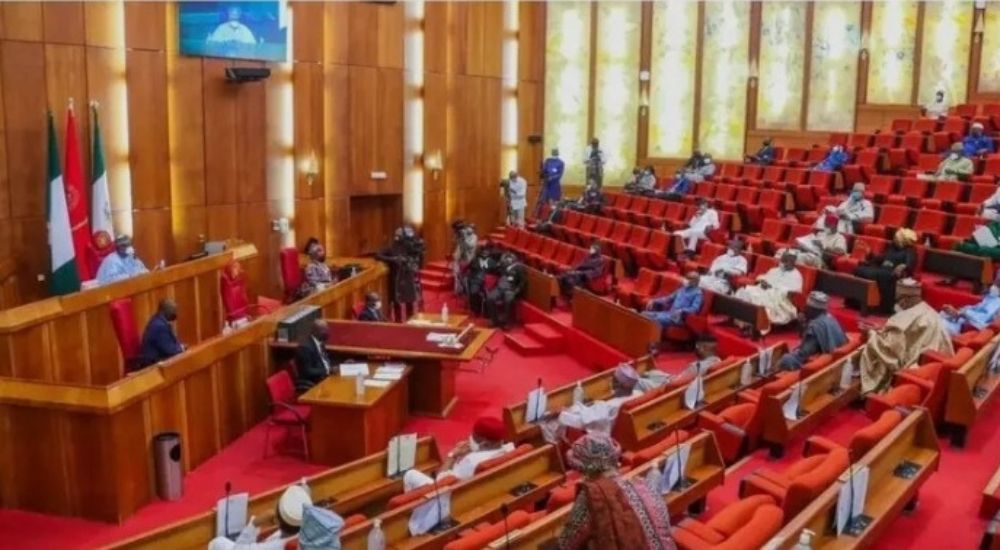
A bill seeking an upward review of the federal government’s share in the existing revenue allocation formula, passed its first reading at the Senate on Tuesday.
The existing formula allocates 52.68 percent of revenue to the federal government, 26.72 percent to state governments, and 20.60 percent to local governments.
Additionally, 13 percent of oil-producing revenue is allocated to derivation, and one percent each is reserved for the Federal Capital Territory (FCT), ecology, and natural resources.
The adjustment can only be effected through constitution amendment, requiring approval of at least 24 of the existing 36 state assemblies.
But the bill, sponsored by Senator Sunday Karimi (APC, Kogi West), hinged the request for higher allocation for the federal government on “increased responsibilities” of the government.
Advertisement
Speaking with journalists after presenting the bill, Karimi listed security and road infrastructure as key areas where the federal government is being drained of revenue.
According to him, the prevailing security challenges across the country is taking a toll on the finances of the federal government.
He also listed legacy road projects, like the Lagos-Calabar coastal road and Lagos-Sokoto superhighway, among others, as major area of the federal government’s revenue drain.
Karimi said, “Even now, there are calls for the Federal Government to hand over certain responsibilities to the states. I agree with that position.
“Roads, for instance, were not originally meant to be the sole responsibility of the Federal Government. Some of them belong to the states, and perhaps they should be returned to them. This will, however, require constitutional amendment.
Advertisement
“We must also agree that there is excessive pressure on the Federal Government. We are on the same page on that. When you consider the security challenges across the country—kidnappings in Kwara, Kogi, Katsina, Sokoto, Borno and other states—the burden ultimately falls on the Federal Government.
“God forbid, but if there is war today, the Federal Government must use available funds to defend the country. Beyond external threats, the internal aggression we are facing is alarming.
“We are dealing with situations where as many as 5,000 insurgents are actively engaged in violence in some areas. In places like parts of Kwara State, thousands of armed individuals are reportedly on the ground.
“This raises serious questions: Who are these people? Who are they fighting? Is this not a form of war? Who is funding them? These are questions we must ask honestly.”
The Kogi West senator said states have been receiving more allocations under the present administration, but that many of the states have nothing to show for it.
“Some states are performing excellently, and we must acknowledge that. However, others are not, and we should not allow poor performance by some to tarnish the image of all.
Advertisement
“There has been unprecedented funding flowing to state governments under this administration. I am not fighting any state government, but we must ask what they are doing with the money?
“That is a legitimate question.
Now, regarding the bill before us, it is clear that it centres on Nigeria’s long-standing issue of restructuring, particularly revenue allocation,” Karimi said.