
UPDATED: Northern Govs Back Tinubu On Security, Demand Swift Action on State Police
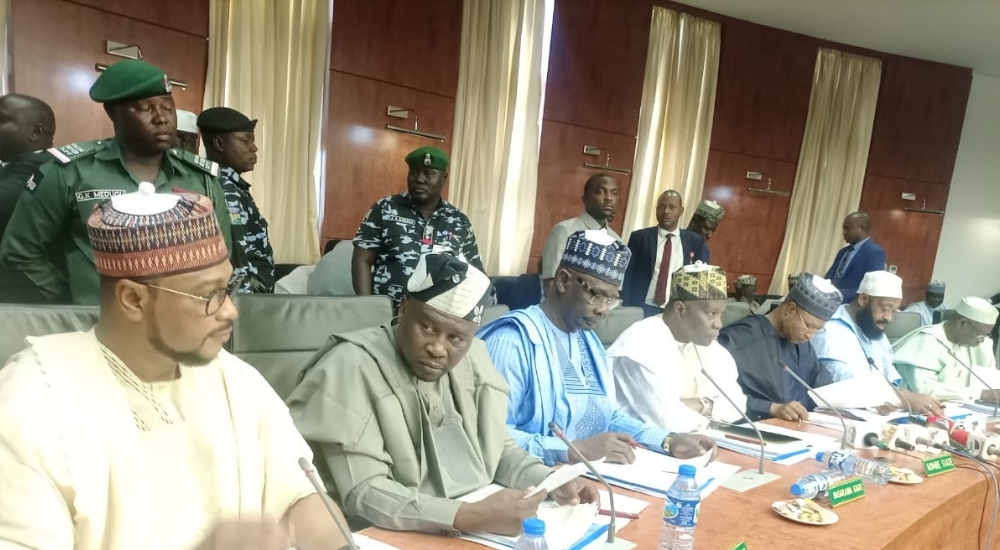
Governors of the 19 northern states on Monday declared firm support for President Bola Tinubu’s ongoing security operations, insisting that the region was facing an “existential threat” that requires urgent, coordinated action across all levels of leadership.
The governors, meeting jointly with the Northern Traditional Rulers Council at the Sir Kashim Ibrahim Government House, Kaduna, also renewed the demand for the creation of state police, warning that the current centralised policing structure could no longer cope with the magnitude of violent crimes sweeping across the North.
The high-level meeting was attended by Governors Uba Sani (Kaduna), Mohammed Bago (Niger), Inuwa Yahaya (Gombe), Umar Namadi (Jigawa), Dauda Lawal (Zamfara), Mai Mala Buni (Yobe), Nasir Idris (Kebbi), Ahmadu Fintiri (Adamawa), Abdullahi Sule (Nasarawa), Caleb Mutfwang (Plateau), Hyacinth Alia (Benue), and Ahmad Usman Ododo (Kogi), while others were represented by their deputies.
In recent weeks, multiple school raids have rocked the region, leaving families traumatised and several communities deserted.
Last week, gunmen stormed Government Girls Comprehensive Secondary School, Maga, in Kebbi State, abducting at least 24 schoolgirls and killing a vice principal.
Barely days later, armed attackers invaded St Mary’s Catholic Primary and Secondary Schools in Papiri, Niger State, where over 300 students and staff were seized before about 50 managed to escape.
Advertisement
The escalating attacks prompted several states to order the temporary closure of schools.
Speaking at the opening session, Chairman of the Northern States Governors’ Forum and Governor of Gombe State, Muhammadu Yahaya, warned that the scale of insecurity had reached a point where “the future of the northern region is being mortgaged.”
Yahaya said northern Nigeria was not dealing with isolated criminal incidents but a broad, multi-layered crisis feeding off years of underdevelopment, weak policing and economic hardship.
“The spate of abductions, terror attacks and rural violence has reached a dangerous level,” he said.
“The targeting of our schools is a direct assault on our collective future. Terrorists attack our schools because they want to destroy the tools that empower our youth.”
Advertisement
He commiserated with states recently hit by mass abductions and attacks — including Kebbi, Kwara, Kogi, Kano, Niger, Sokoto, Borno and Yobe — describing the incidents as deeply distressing.
“Our deepest condolences go to the governments and people of the affected states,” he said.

The NSGF chairman praised President Tinubu for “leaving no stone unturned” in efforts to secure the release of some kidnapped schoolchildren, expressing confidence that others still in captivity would be safely returned.
Yahaya stressed that the governors fully supported Tinubu’s counter-terrorism operations despite growing international scrutiny.
Advertisement
“We welcome constructive support from international partners, but such help must respect the dignity, territorial integrity and complexities of our country,” he said.
Yahaya said northern leaders must also confront the deeper socio-economic triggers of insecurity if the region is to make sustainable progress.
“The roots of our crises lie in deep-seated problems of underdevelopment, illiteracy, lack of opportunities, environmental degradation and poor resource management,” he noted.
He warned that failure to address the rising population of out-of-school children and the persistence of the Almajiri system would continue to fuel radicalisation and crime.
“The reality of millions of Northern children roaming the streets instead of being in classrooms is unacceptable. We must move beyond rhetoric and take coordinated actions to put every child in school,” he added.
Yahaya emphasised the need for massive investments in infrastructure — roads, rail lines, power and digital connectivity — to unlock regional economic growth.
A major highlight of the meeting was the renewed call for state police. Yahaya said the NSGF had long endorsed the reform, citing its inclusion in the forum’s May 2025 communiqué.
“We are greatly encouraged by President Tinubu’s recent pronouncement urging the National Assembly to create the enabling constitutional framework for state policing. We urge federal and state legislators to accord this initiative the priority it deserves,” he said.
According to him, a decentralised policing system remains the “most practical and effective mechanism” for tackling the country’s security challenges.
He urged traditional rulers, religious leaders, security agencies and the judiciary to intensify their roles.
“Perpetrators must be held accountable so that justice becomes a deterrent,” he said, calling for faster prosecution of offenders.
Host governor, Senator Uba Sani of Kaduna State, used his welcome address to warn political actors against the “deliberate politicisation of insecurity”, insisting that such behaviour was sabotaging regional stability.
“A few voices, driven by narrow political motives, have worked to create the impression that Northern Governors have grown complacent or inattentive. Nothing could be further from the truth,” he said.
He described as dangerous the trend where some opposition figures allegedly amplify fear and distort facts to score political points.
“This behaviour is reckless. Politicising insecurity undermines collaboration, weakens morale, emboldens criminals and threatens the stability of our entire federation,” he warned.
Sani argued that governors in the region have been working “tirelessly” to coordinate intelligence, share strategies and strengthen interstate security arrangements.
“Every governor seated here works tirelessly to secure our communities. We coordinate, compare strategies, share intelligence and hold one another accountable,” he said.
He dismissed claims that insecurity worsened under President Tinubu, insisting instead that the President had been responsive to northern concerns.
“We have a president who understands the North, values the North and consistently demonstrates respect for our perspectives,” Sani added.
Sani also backed full decentralisation of policing, noting that Nigeria’s current centralised model could not effectively police a population of over 230 million people with fewer than 400,000 officers.
“Nigeria’s centralised policing model can no longer meet the demands of a nation with vast ungoverned space. State police is no longer a regional demand; it is a national imperative,” Sani said.
He urged the forum to send a united message to northern communities that their leaders remained focused and committed.
“Let us reclaim the narrative of the North from those who thrive on fear,” he said.
Also speaking, the Sultan of Sokoto and Chairman of the Northern Traditional Rulers Council, Alhaji Sa’ad Abubakar III, urged governors to double their efforts and work with absolute unity to rescue the North from its mounting challenges.
He dismissed speculations that the meeting was an emergency intervention triggered by recent attacks, saying it had been long scheduled for review and assessment.
“This meeting was supposed to be held in September but was put off a couple of times for various reasons. It is not an emergency meeting,” he explained.
The Sultan expressed the full support of the traditional institution for the governors, pledging collaboration in the fight against insecurity, poverty and social dislocation.
“As leaders, we need to tell ourselves the truth. But I want to assure you—just listen to the governors—we are 100 per cent with you in this drive to make the North a better place because we don’t have any other place to be,” he said.
He urged political leaders to resist divisive tendencies and remain open to constructive criticism, saying that “listen to critics. Listen to criticisms. Make amendments whenever they arise.”
Abubakar III said traditional rulers would continue offering counsel and support when needed. “You have our confidence; you have our trust. You can reach out to us any time of the day,” he told the governors.
He also renewed his call for continuous prayers for national leaders. “Please pray for our leaders. When you pray for them, and they do good things, we all enjoy it,” he said.
The meeting, which began on December 1 and is expected to conclude later today, will issue a communiqué outlining new security resolutions, development strategies and steps toward strengthening regional cooperation.