
How Enugu Increased IGR To N406.8bn Without Raising Taxes – IRS Boss
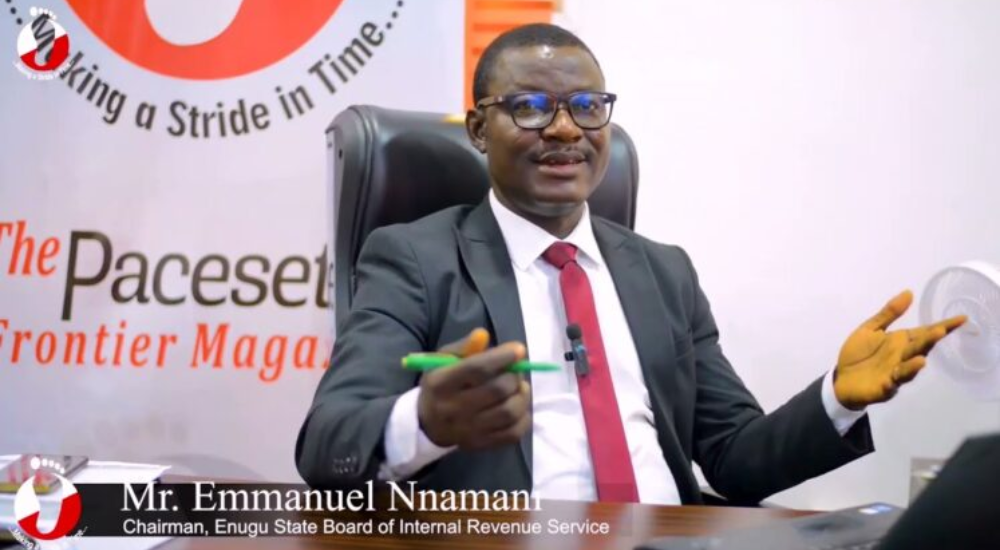
The Chairman of the Enugu State Internal Revenue Service (ESIRS), Mr. Ekene Nnamani, has explained that the state increased its Internally Generated Revenue (IGR) without raising taxes by reforming tax administration, digitising revenue collection, unlocking non-tax revenue sources and investing in strategic assets.
Speaking in an interview with THE WHISTLER, Nnamani said the state shifted from relying on traditional tax sources to tapping previously underutilised sectors of the economy.
His explanation comes amid growing interest in the sharp rise in the state’s revenue under Governor Peter Mbah’s administration.
Data from the Nigeria Governors’ Forum showed that Enugu generated N28.69bn in 2022. The figure rose to N33.86bn in 2023, the year Mbah assumed office, before climbing to N180.5bn in 2024 and N406.8bn in 2025.
Nnamani said the reforms began with overhauling the state’s tax administration through technology deployment, stronger enforcement against tax evasion, improved staff capacity and a shift towards a performance-driven culture.
According to him, the government digitised tax operations, equipped staff with modern tools, partnered leading professional firms for training and introduced performance-based incentives.
Advertisement
“We could no longer believe in those factory revenues. It will not power our development. We looked at the potential we have and discovered that our potential is much more than what we were doing.
“Digitising service, providing digital tools, refocusing their mindset from civil service to a private sector-driven mindset, having their work environment look like something that is enticing, making the service a professional entity. Then, we started seeing a rise in the tax revenue,” he said.
The ESIRS chairman said the reforms expanded the Pay-As-You-Earn (PAYE) tax net and significantly increased tax receipts. He added that granting operational autonomy to the revenue service played a key role in the agency’s performance.
Beyond tax collection, Nnamani said the government also focused on non-tax revenue by reforming the land administration system.
He said the state introduced a Geographic Information System (GIS) to digitise land registration, documentation and title administration.
Advertisement
“Then in the non-tax revenue, what we did was to implement a reform within our land sector ecosystem. So, if you look at the southeast, you see that the only investments people in the southeast believe is when they have invested in land and property. So, that ecosystem provided a massive opportunity and we had to reform that sector,” Nnamani said.
He said the government also began allocating land at prevailing market values while deploying technology to improve transparency and traceability in land transactions.
“So, we allocated our land at the market value, brought in technologies that ensured that land allocated are sealed, documented and traceable. That happened and our revenue rose astronomically,” he said.
Nnamani also disclosed that the state revived dormant public assets through investments, leasing arrangements and equity sales.
According to him, projects including the revitalisation of United Palm Products, the International Conference Centre, Niger Gas, water facilities and the leasing of the Nike Lake facility generated billions of naira for the state.
He further attributed the state’s revenue growth to investments in transport, urban development and the informal sector.
Advertisement
According to him, Enugu established a 10,000-hectare Smart City, acquired six aircraft, introduced compressed natural gas (CNG) buses, built five international-standard bus terminals and digitised revenue collection in the informal sector through electronic ticketing.
“It is not rocket science,” he said, noting that digitisation and institutional reforms had made revenue collection more efficient.
On how the increased revenue is being utilised, Nnamani pointed to investments in education and healthcare.
He said the state had built 267 smart schools across rural communities and established solar-powered smart primary healthcare centres in every political ward.
“In Enugu state, we abandoned the old educational system whereby people sit in a mud house or don’t even use chalk, chalkboard or blackboard. We abandoned it entirely,” he emphasised.
Looking ahead, Nnamani said the state aims to generate about N870bn this year through the sale of optimised assets, Smart City land sales, expanded property registration, coal mining activities and improved tax collection.
He disclosed that about 3,000 hectares of the Smart City had already been developed and were being offered to investors under a structured development plan covering parts of Enugu East, Enugu South, Nkanu East and Nkanu West local government areas.
He added that the government was opening up previously undeveloped areas through road construction, electricity, fibre-optic infrastructure and plans for a metro transport system to connect rural communities with the state capital.
Nnamani also urged members of the public to verify the projects and the state’s revenue performance through official government platforms, including budget documents, the Nigeria Governors’ Forum and BudgIT, or by visiting project sites across the state.