INTERVIEW: How I Became Cattle Rearer- Female Igbo Herder
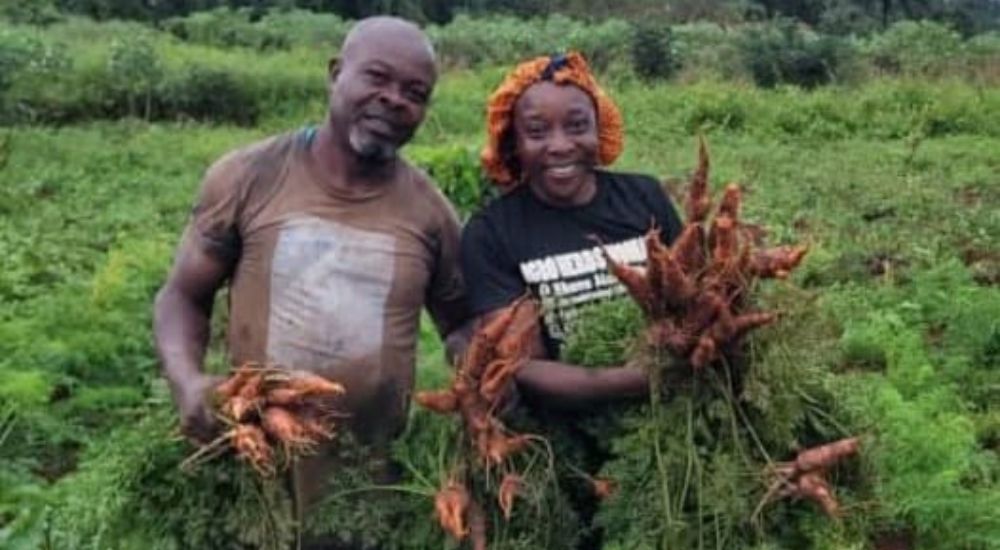
Mrs Ekele Obayi is a native of Nguru, in Nsukka Local Government Area of Enugu State. A graduate of Archeology and Tourism from the University of Nigeria, Nsukka (UNN), Obayi ventured into farming after struggling to find a white-collar job.
In an exclusive interview with THE WHISTLER‘s Nneka ASOGWA, Obayi shares her remarkable journey from being the first female Igbo herder to becoming the leading carrot farmer and distributor in South East Nigeria.
You have been getting a lot of attention as the first Igbo female herder. What inspired you to take up this path?
The cattle farming started with my father in-law. He was the person that taught my husband how to rear cattle even before I got married to him. So, it is a family business. However, I got into it the moment my husband had an accident. While he was in the hospital, he was lamenting about who will take care of his cattle. As at then, I was teaching in a private school. I was not doing the farming with them initially.
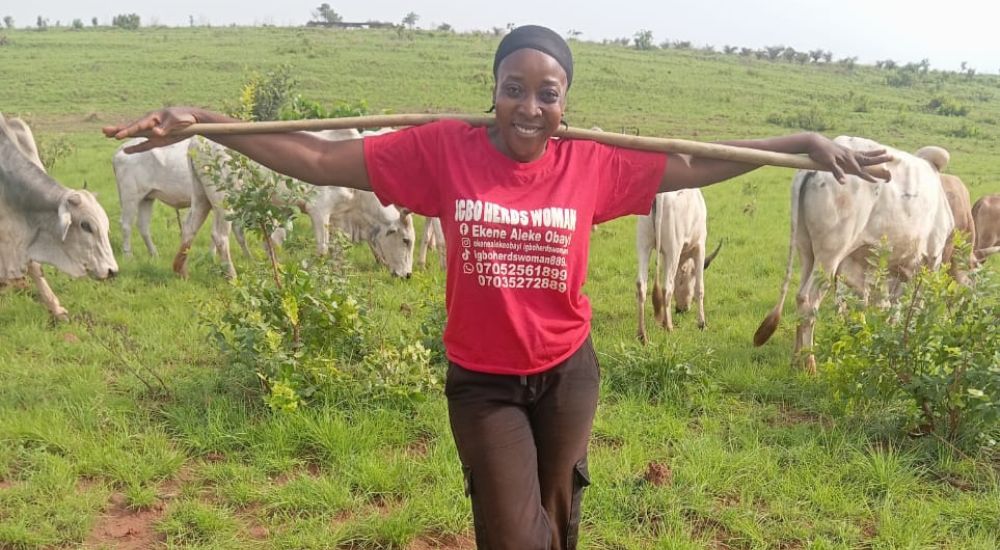
So, I tried convincing him to take his mind off the cattle that they will be alright…, that he should recover first. But he kept on being worried about the cattle. I had to asked him to teach me what to do so I can take care of them. He was able to tell me some things about it and I picked up.
Advertisement
January 3, 2020, was the first time I took the cattle to bush to graze. We had only three cattle then. I took them from Nguru to Obimo, which is about 36 kilometres distance, and they followed me the way they follow Fulani herdsmen.
From that day, I got motivated and added more interest in cattle rearing. I even took over the cattle rearing, when my husband finally recovered. Each time I go out with the cattle, I took pictures with them and post on social media and tag it “Igbo herdswoman.” I didn’t even know that no woman has ventured into cattle rearing. After my post, some media houses carried the news and started interviewing me as the first female herder in Igbo land.
So, initially I was not interested in cattle rearing, but now, I don’t know if I will say that it is destiny, but what pushed me into it was accident. I never planned to become a female herder.
How did your father-in-law get into rearing cattle?
I don’t know, but I know they started with native cattle before this high breed now. You know it was just native cow that is being sold here in Nsukka. I don’t know who initiated my father in-law and I was not able to ask him till he died. He died even before I started rearing cattle.
Advertisement
Did you encounter any challenge rearing the cattle especially with the Fulani herdsmen?
No, I did not, my only challenge now is with farmers, and that is because I do not have a ranch yet. You know, whenever these cattle enter their farms it becomes a problem because they must destroy something and that will make the farmers very aggressive.
The only challenge I will say I had with Fulani Herdsmen was in 2021, when our cattle ran out and joined the Fulani’s at a place called Akachele in Obimo. However, it turned out to be a blessing to me. The Fulani herdsmen occupied the area then. They also had a camp at Ezeani but I don’t know if they are still there now.
It was in the process of searching for the cattle that somebody directed us to go there and ask them. On getting there with my husband, they were so surprised and at the same time excited to see that a woman is a herder.
They later gifted me one cattle seeing the boldness and courage in me doing the work. Initially they doubted me, but after giving me time to take some cattle around for some distance, they became convinced that I am very much capable for the work.
When we go to Lafia to buy cattle… because I am the only female there, they always give me good discount. In fact, I will say that I have a good business relationship with them.
Advertisement
Being a female herder, did you face any criticism?
Yes, I faced a lot of abuse and criticism both from my father’s side and from my husband’s side. People said a lot of negative things to me, even my parents. Things like, you are a graduate and all you could do is to carry cattle up and down like Fulani people. But I was never discouraged, I already have passion in agriculture.
Apart from cattle rearing, you have also ventured into crop farming. How did this come about?
I ventured into a full-time farming after I graduated from school and could not secure a job. Though, I started with rearing of cattle. It was the manure I am getting from my cattle that pushed me to farming. You know, having all that manure, I thought of how to utilize it, then the idea of vegetable farming came in, which I started with tomatoes, followed by yellow pepper, popularly known as “Ose Nsukka”. Then the next year, the thought of carrot and other vegetable crops came in. I said to try carrot first.
What other crops are you cultivating, and what inspired you to grow them, considering they are not commonly grown in the eastern region?
I cultivate other crops like bell peppers, cabbage, green beans and cucumber. I didn’t learn it anywhere, I was not trained by anybody, I just said to try, and it worked. It was just a personal trial and it worked well. Though, I am still trying to find out the most favourable weather for it here, considering that our weather is a bit different from that of the North where they are largely cultivated.
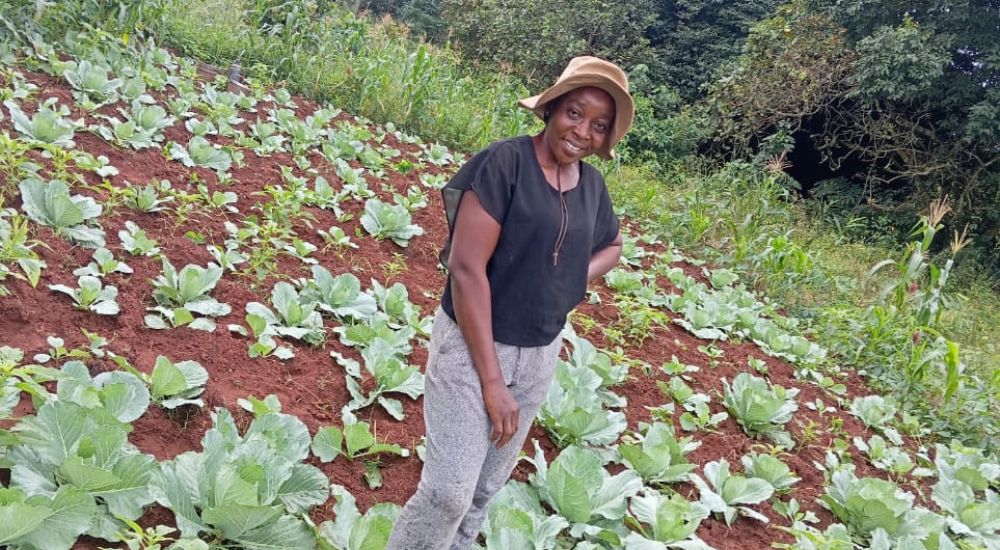
How and where do you sell your crops, especially carrots, given that you are a leading distributor in the South East?
In Nsukka here, we have Ogige Market and Ikpa Market where all these crops are sold but I rarely take mine to market. I sell online and also some people come to my farm to buy. People also from within and outside Nsukka call to buy. I also have customers in Ogige and Ikpa Market. They often come to my farm to buy too. My carrot especially… it is very lucrative. It does not even go round to all that need it, and this is because I use organic manure
I also have customers from other states like Lagos, Ogun, Abia, Anambra, Delta, Imo, and Abuja. I waybill crops to them, and the reason is that I market my farming online, through WhatsApp, Facebook, YouTube. So, they always contact me through social media to buy.
When it is time to sell, do you see other farmers with similar crops at the market?
I have not seen others. That is why I am planning to train people on it now. I have a social platform already where I intend to train people on how to cultivate those crops so we can have it in large quantities from the east. Already, many people from different states in the east have indicated interest in the training.
Do you face any challenge in your crop farming?
Actually, I have a lot of challenges… on the cattle side, I have a local ranch where I keep my cattle after grazing. For that ranch to grow effectively, I need a borehole and more hectares of land to build a very wide ranch, fence it, and grow grasses in it. That way, we won’t be going out to graze, thereby reducing the stress of walking a long distance every day in search of grazed land for the cattle. This will also reduce the damages they cause in people’s farmland. The borehole will make water available for us to water the grazed land always. So, in a nutshell, I lack finance to carry out these projects.
On the side of crop farming, I also need money to expand the farming. If I have good capital now, I will be using machinery in the farming and hire more labourers to help in the in the work.
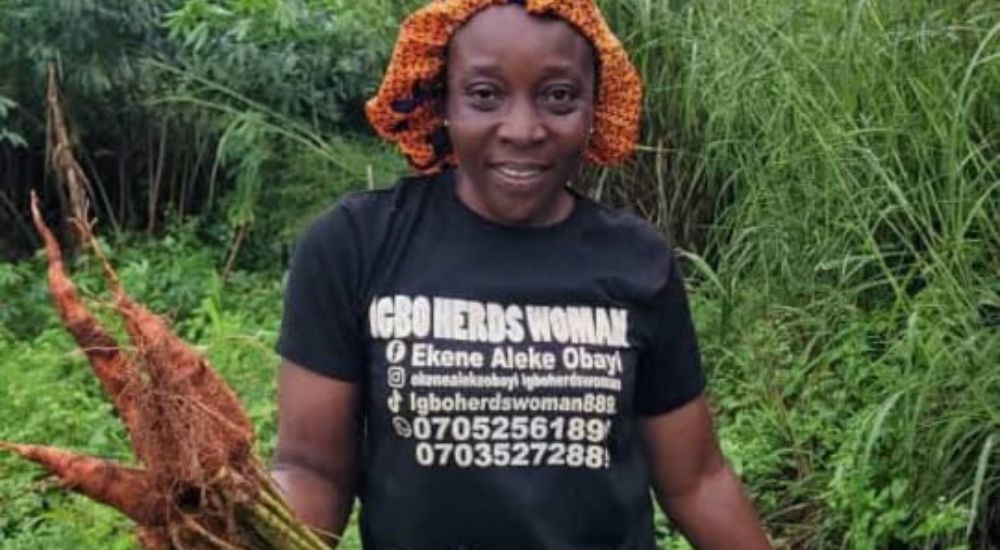
So, I need land, and capital to expand and carry out the job effectively.
All these needs good capital to carry them out. Also, this ranch is not built near residential places, so, it demands big hectares of land far away from where people are living. Actually, I wrote business proposal for this farming. I had to go to places where there are ranches to see how it is built, and also asked questions about it.
To overcome this challenge, I would need government’s intervention or people of goodwill in Enugu State to sponsors us financially so that we can expand our crop and cattle farming very well in Nsukka and Enugu State as well.
How do you treat your cattle when they fall sick?
If you have a cattle ranch, you should have a veterinary doctor, so we always call on them whenever the need arises. Although, that one is another problem facing me, because I am supposed to have a ranch to enable me apply a veterinary doctor that should be coming time to time to check them and treat them if need be. But now that I don’t have, most times you would need them, they would not be available, by the time they come your cattle must have died or gone beyond control.
How do you manage to balance your responsibilities as a wife, mother, and farmer, juggling two demanding roles?
We already have a mutual understanding on this farm work. We always do division of labour. During rainy season, my husband will be in charge of cattle, while I go into farming. I will still employ people to help in the farming, because the crop farming is still not a one-man job. It needs many hands.