
Rwanda Signs Nuclear Cooperation Deal With U.S.
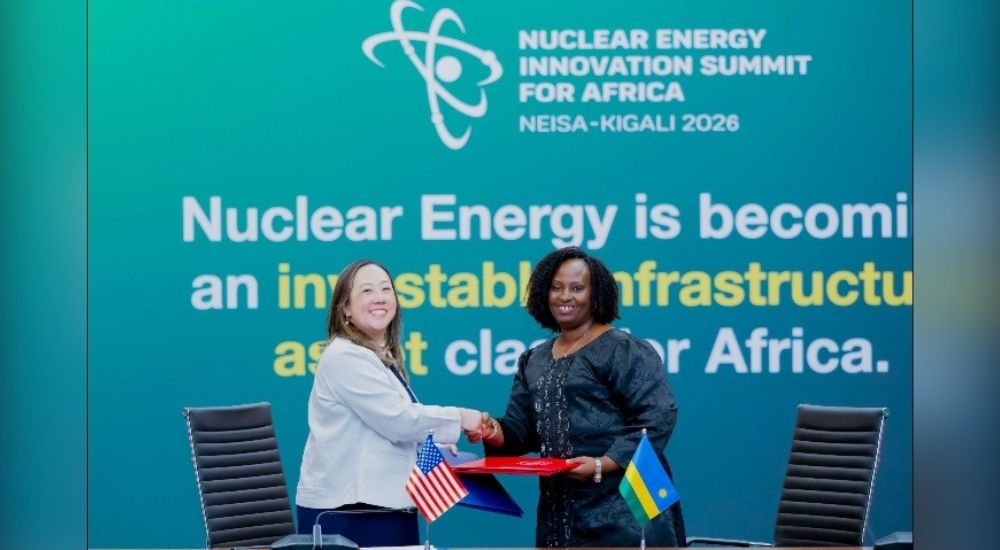
Rwanda has signed a civil nuclear cooperation agreement with the United States and a separate development deal with U.S. company Holtec International, formally launching efforts to assess whether small modular reactors could help address the country’s chronic energy shortages and support its long-term industrial ambitions.
The agreements were signed on Tuesday in Kigali on the sidelines of the second Nuclear Energy Innovation Summit for Africa.
The summit, hosted by President Paul Kagame at the Kigali Convention Centre, runs from May 18 to 21 under the theme: “Powering Africa’s Future: Turning Nuclear Energy Ambition into Investable Reality.”
The Memorandum of Understanding on Strategic Civil Nuclear Cooperation was signed between Rwanda and the United States government, with Renee Sonderman, a senior U.S. official in the Bureau of Arms Control and Nonproliferation, representing Washington at the ceremony.
“We are expanding and deepening civil nuclear partnerships with the aim of positioning American companies to export the safest, most advanced nuclear technology to responsible partners globally,” Sonderman said.
Advertisement
The separate agreement with Holtec, a New Jersey-based nuclear technology company, focuses on assessing the possible deployment of the company’s SMR-300 small modular reactor units in Rwanda.
A Rwandan official said the agreement was intended to evaluate potential sites and determine whether the SMR-300 technology could be deployed once it reaches commercial maturity.
Small Modular Reactors, or SMRs, are scaled-down nuclear reactors designed to be cheaper and faster to deploy than conventional nuclear power plants.
They have attracted growing global interest as a potential solution to energy insecurity, particularly in developing countries, although experts caution that the technology is still evolving and widespread commercial deployment remains years away.
Opening the summit, President Kagame said access to affordable, reliable and clean energy was critical to Africa’s industrialisation.
Advertisement
“Nuclear energy offers a strategic opportunity to address persistent power shortages, support emerging industries and meet the needs of a rapidly growing population,” he said.
Rwanda currently generates most of its electricity from hydropower, leaving the country vulnerable to drought, alongside methane gas extracted from Lake Kivu.
Total installed capacity remains well below what is required to support Rwanda’s growing industrial ambitions under its Vision 2050 development plan.
Tuesday’s agreements with Washington and Holtec are the latest in a series of nuclear cooperation deals Rwanda has pursued in recent years.
The country signed a nuclear cooperation agreement with Russia’s Rosatom in 2018 and, in 2023, signed a memorandum with Canadian-German company Dual Fluid to develop a demonstration reactor on Rwandan soil, originally expected to become operational in 2026.
Last year, Rwanda’s Prime Minister Justin Nsengiyumva met U.S. Secretary of Energy Chris Wright in Washington to discuss nuclear and natural gas cooperation, laying the groundwork for Tuesday’s formal agreement.
Advertisement
Rwanda is not alone in its nuclear ambitions.
The NEISA summit brought together governments from across Africa, alongside the International Atomic Energy Agency, the OECD Nuclear Energy Agency and major international financial institutions, to discuss how nuclear energy can be financed and deployed at scale across the continent.
South Africa remains the only African country with an operational nuclear power plant, though several other African nations are exploring nuclear energy as governments seek alternatives to unreliable grids, rising energy demand and dependence on fossil fuels.