
Tinubu Determined To Win 2027 Election By Every Means, Onaiyekan Warns
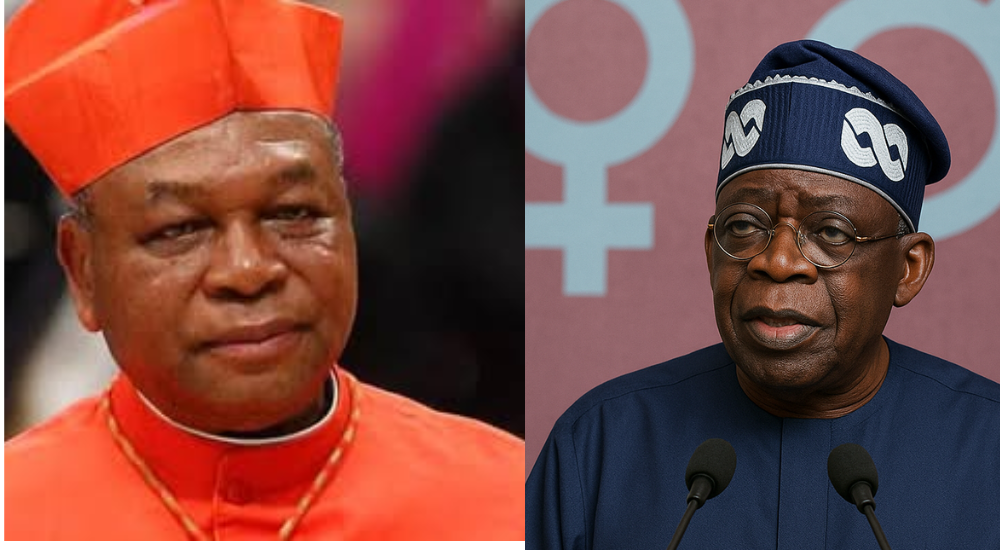
Archbishop Emeritus of the Catholic Diocese of Abuja, Cardinal John Onaiyekan, has said President Bola Tinubu made it “quite clearly” known that he disagreed with concerns raised by members of the Catholic Bishops’ Conference of Nigeria (CBCN) during a meeting at the State House, Abuja.
The bishops met with Tinubu on July 28, where they raised concerns about the economy, insecurity, and the country’s political climate.
Speaking with ARISE NEWS on Friday, Onaiyekan said the President responded directly, disagreeing with their assessment.
“When the nation is bleeding, you cannot expect a polite meeting with the Head of State. We had to let him know. And his reply is that the nation is not bleeding. We told him the economy is not helping our poor people; he told us the economy is doing fine. Frankly speaking, he told us quite clearly that he did not agree with us,” he said.
“Again, we were not surprised. We didn’t expect him to agree with us. We have done our duty, we have delivered our message, and we have a feeling that somehow, along the line, somebody will show him a few of the things we said,” he added.
Onaiyekan maintained that the bishops’ statement was the product of broad consultations within the CBCN, stressing it reflected the collective position of the conference rather than a few individuals.
Advertisement
“Let me say first and foremost that that statement read by our president was not just put together at random. It was carefully considered and with wide consultation. The Bishops’ Conference is bigger than the group of us that were there, but it is very representative of the Bishops’ Conference.
“So, it is the Catholic Bishops’ Conference that produced that document. It was written, rewritten, and corrected. So it was not done at random, nor did we deliver it with levity,” he stressed.
He added that the bishops had no political ambitions. “I think I have an opportunity in this program to remind Nigerians that, as bishops, we have no ambitions to take Mr. Tinubu’s job or anybody else’s job.
“We are not politicians running for office. We are, first and foremost, religious leaders who feel we have a duty – not just to preach our religious doctrines, but also to address the lives of our people, both those who are our members and those who are not. You can see that from the content and the tone of our statement,” he said.
Onaiyekan said he was not surprised that Tinubu appeared unhappy while listening to the bishops’ statement, noting the delegation deliberately presented what it believed was the country’s reality rather than a favourable picture.
Advertisement
“You asked me what I saw on the face of the President in reaction. I was not surprised that he was not looking very happy, nor were his colleagues who were there. We knew that this is different from the kind of statements that our President keeps receiving from all kinds of people. That is one of the things that worries us: there are so many people hanging around Mr. President, giving him a rosy picture of what the country is, which it is not,” he said.
“We felt that we have a duty not to do that. Indeed, we have the obligation to help him appreciate the reality of the situation in which we find ourselves. That is the reality that we painted, which I know is not the kind of thing that he wanted to hear. And his reply showed that very clearly,” he reiterated.
Despite the disagreement, Onaiyekan said the bishops left the meeting convinced Tinubu had heard their concerns because he responded directly to the issues raised, though he expressed hope that those around the President would encourage him to reflect further.
“He heard it, and he tried to tell us that he heard us, which is precisely why he replied the way he replied. He replied to the points we raised and disagreed with them, so he must have heard it.
“The real question now is: Is this disagreement his final position, or will there be people around him whose job it is to draw his attention that these guys who came here in white garments have not made any personal requests for oil wells or any particular personal things, and maybe he should listen to what they are saying?
“We believe one of the problems within our government right now is that there are not too many people telling him the truth, which is a pity. We need to have that, whether in terms of the economy, insecurity, and above all, the area of the political climate,” he said.
Advertisement
Turning to the country’s political climate, Onaiyekan said the bishops’ warning about the “creeping danger” of a one-party dominant state was informed by concerns over the conduct of elections and the growing use of the powers of incumbency.
“The position of Mr. President came very clearly in that statement that he made: ‘In politics, all is fair.’ Is that true? If that is what politics is – that in politics everything can be done provided you win elections. That is certainly not correct. There is propriety in everything. That is why we are worried about it.
“We are worried about the fact that we see clearly that our government is bent on winning by all means, and unfortunately, they have a lot of means at their disposal to win.
“They are deploying all those means in a way that eventually, even if we had a free and fair election, the votes of the people may not count.
“We gave two warnings. The first was the one you mentioned. The second is that if we do not rearrange our election system to make sure that elections are really free, fair, and credible, it can lead to difficulties,” he stressed.
Continuing, he said: “We warned that the country doesn’t gain anything by a one-party state in a so-called democracy. Of course, we are not expecting Mr. President to help the opposition to defeat him – no. But the point we are raising is that even though the President has all the powers of incumbency, in the election, he is a candidate like any other.”
Responding to Tinubu’s defence of INEC at the meeting, where he declared INEC neutral and denied allegations that it favours the ruling party or intimidates opponents, Onaiyekan argued the commission’s neutrality would continue to be questioned as long as its members are appointed by the President.
“He said that INEC is independent, but words are not enough. The Nigerian political system, the way it is now constructed, precisely is leading to a situation where INEC cannot be independent. The chairman, all the members, and all the commissioners have been appointed by the President.
“The presumption is that Mr. President will appoint independent, impartial, wonderful people. But on the ground, we see that standard politicians and members of his party are appointed. This means we have a situation where until we find a system where the membership of the electoral commission is put together not by Mr. President, but by a truly independent entity, that would remove the doubts.
“And that is not an impossible thing to do; it is done elsewhere. We could do it if we wanted to do it. Whether our present President is in the mood to go that direction, I don’t know,” he said.
Urging Tinubu to strengthen Nigeria’s democratic institutions, Onaiyekan said the President’s reputation as a pro-democracy figure should be reflected in reforms guaranteeing a level playing field in elections.
He added that the bishops were not acting on behalf of any political party but were united in speaking out on the economy, insecurity, and democratic governance.
“We are hoping that that kind of statement challenges him – that you have a reputation to be a democrat, and you can’t under your watch watch our democratic structures disintegrate.
“Silence is consent, so he must agree with what we said. How he will do it, we don’t know. We still have this problem in Nigeria of how incumbents can simply allow a free and fair playground in elections. We still have that problem.
“I think we have done our duty. I have the feeling that somehow, there are people around him – they may not change everything overnight – but I hope nobody thought that any political party was sending us.
“There’s no way any political party can gather that kind of group from different parts of Nigeria. Is it that bishops have no political feelings of their own? We do have differences.
“But when it comes to what is important for Nigeria, when it comes to our existential existence, when it comes to the life of our people, we are united.
“We are united that we deserve more than what we are getting now. Therefore, when the government keeps congratulating itself, we feel that this is misplaced. Because it is not even looking at the difficulties, they are not doing enough to address those difficulties,” he insisted.
Turning to the forthcoming Osun State governorship election, Onaiyekan defended the work of the National Peace Committee despite concerns that peace accords have become largely symbolic.
“Let me express my mind on this National Peace Committee. On the one hand, from the experience I got in Osun State, people are expecting a lot from this body called the National Peace Committee, and because of that, I will continue to work there. On the other hand, there’s a feeling that people just come and sign, and then they go about and do whatever they like. Therefore, it’s not worth the trouble.
“My own conclusion is that it is useful, and we must find a way of reviving it,” he urged.
He disclosed that during the signing of the Osun Peace Accord, the state’s governor voiced strong reservations, alleging that members of his party were being targeted and unfairly treated.
“I must say, the Osun State signing was very interesting. And the Governor right away fired broadsides. He told us very bluntly, ‘I would not have gone for that charade of a peace accord if it was not because of the great respect I have for you people in the National Peace Committee. Because you have come for it, I will be there.’
“He gave us his reason why he felt that way, being very blunt that the ruling party was making it impossible for his party to survive in what we are doing. Specifically, he claims that his members are targeted, framed, imprisoned, and some even targeted for physical elimination.
“He was particularly livid that the evening before, his Secretary to the State Government had been arrested.
“I am hearing now that the Secretary to the Government has been released, at least to give a cooling off. That was what he was saying. Of course, you know that this is the kind of thing we are used to seeing.
“That makes the Osun election very interesting because the incumbent governor is not of the ruling party. That is how it should be. There is no reason why governors must all be of the same party with the President,” he said.
Onaiyekan expressed confidence that the bishops’ message to Tinubu would have an impact despite their differences during the meeting.
“We have delivered our message, and we are quite convinced that it will not go for nothing. It has a way of making an impact. At least we have expressed the feelings of many Nigerians who have no way of meeting Mr. President,” Onaiyekan concluded.