Why Lamido Was Excluded From PDP Convention – Sani
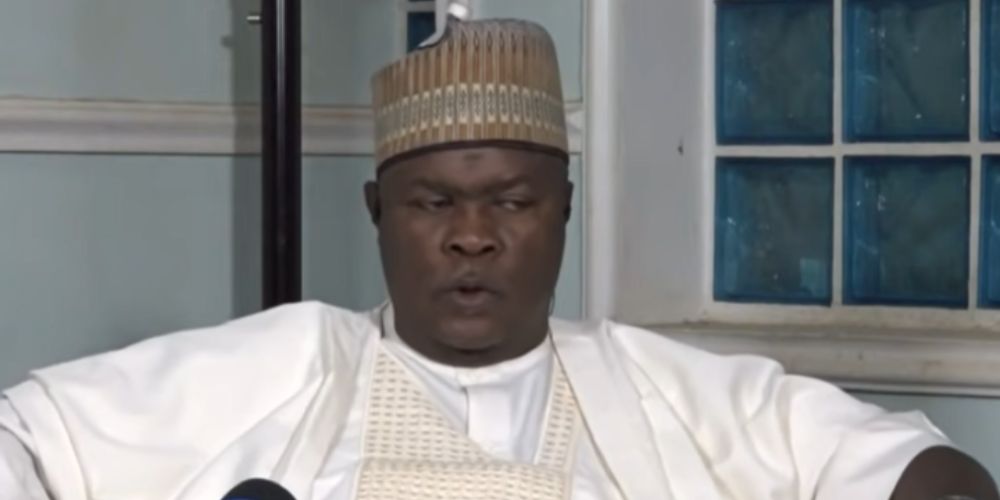
A Chieftain of the Peoples Democratic Party (PDP), Umar Sani, has explained why a former Bauchi State Governor, Sule Lamido, was not allowed to participate in the Ibadan National Convention that produced the Kabiru Turaki-led National Working Committee (NWC).
Speaking during an interview on Arise News on Wednesday, Sani said Lamido failed to go through the right processes of obtaining the form for the chairmanship position.
He said the controversy surrounding Lamido’s attempt to obtain a nomination form is part of the legal dispute that led to the nullification of the party’s national convention.
He made this remarks while reacting to the ruling of the Court of Appeal which faulted the conduct of the convention over the alleged exclusion of Lamido from the contest for the party’s national chairmanship.
Recall that the Court of Appeal sitting in Abuja had recently invalidated the PDP elective convention held in Ibadan.
Advertisement
The convention had produced Kabiru Turaki (SAN) as the National Chairman of the party.
Delivering a unanimous judgment on Monday, a three-member panel of the appellate court held that the appeal filed by the PDP lacked merit.
The panel resolved the four issues raised for determination against the party and affirmed the October 31 ruling delivered by Justice James Omotosho of the Federal High Court of Nigeria.
The lower court had granted all the reliefs sought by the plaintiffs, including restraining INEC from recognising the outcome of the planned convention.
However, Sani while responding to claims that the party ignored an earlier court directive and proceeded with the convention, said the court misinterpreted the circumstances surrounding Lamido’s attempt to join the race.
Advertisement
“In the Sule Lamido case, it is very clear that Sule Lamido came to buy form on the day that it was scheduled for the return of completed forms.
“The party had already scheduled sale of forms under the Convention Planning Committee, which headquarters was domiciled at our other office, our annex, which is the Legacy House. And Sule Lamido went to Wadata Plaza to purchase form on the day, on the final day for the submission of sale of forms,” Sani said.
According to him, the party had clearly published the timeline for the sale and submission of nomination forms, and other aspirants complied with those guidelines.
He said, “Those who were interested, like Senator Olado from Katsina, bought the form at the prescribed time. There was a time for filling and submission of forms. It was when the time came for the filling and submission of the form that Sule Lamido now showed interest to contest.
“By showing his interest to contest, he now went to Wadata. I don’t want to say they arranged with Bature and Anyanwu, but he went to Wadata to meet people who are not in charge of sales of forms. He went to meet the National Secretary, who is not in charge of forms,” he said.
He maintained that despite presenting these arguments during the court proceedings, the appellate court failed to “look at the wisdom of their argument” and give them adequate consideration.
Advertisement
“Even with that argument, the court played deaf to our argument and we felt that the court erred in law by not listening to us.
“Even at that, the court didn’t say that we should not go ahead. They said we should open a room for him to participate in the convention,” he said.
But according to Sani, the party felt that allowing Lamido to participate in the convention without purchasing a nomination form would violate the PDP’s constitution and established procedures.
“Yet the Court says every decision it is taking is reliant on our constitution. And yet, it is determining this very important aspect of our constitution. So we felt these are issues, you know, clearly for determination by the Supreme Court,” he said.
Sani also dismissed allegations that the party engaged in forum shopping by approaching different courts over the dispute.
According to him, the party did not initiate the cases but was sued by aggrieved contestants.
“In the Ibadan High Court, it was a contestant for the office of National Deputy Organising Secretary that took the party to court,” he said.
“It was not the party that went to Ibadan looking for somebody, a judge, to give a favourable judgment.”
He added, “In Justice Omotosho’s issue, we didn’t go to court. In Justice Lifu’s issue, we didn’t go to court. We were all sued. So we were responding to the outcomes of those issues.”
Sani also said the dispute has left the party in a difficult position, noting that the court ruling invalidated the authority of some officials who had claimed legitimacy within the party.
“As it is now, you know, it is like the party is not being driven by anybody. The party is a standalone party, not driven by any side,” he said.
“The authority which the Wike people said they had, and with which they had formed all their Board of Trustees at the end of the year, was squashed because the court maintained and affirmed that those people were under suspension at that time and could not have performed any legitimate function of the party.”
Also reacting to suggestions by former Senate President Bukola Saraki that the PDP should accept the ruling and organise a fresh convention to avoid jeopardising its chances ahead of the 2027 elections, Sani warned that doing so could create further legal complications.
“The issue of a national convention, again, will amount to double jeopardy,” he said.
“They are saying our convention is illegal, and then they want to hold a convention. On what premise will they hold a convention?”
However, Sani said the party’s leadership had already met to deliberate on possible options, including approaching the Supreme Court of Nigeria.
“The NWC and the BOT met yesterday to formulate three grounds where the party will be heading to.
“The first is that the possibility for us to go to the Supreme Court, which will now be debated today. The second one, I wish to keep it because it is our strategy, But the last one is to embrace the issue of reconciliation as propounded by the court,” he said.
He explained that reconciliation could follow the advice earlier given by another division of the appellate court which urged party members to resolve their differences internally.
“That reconciliation, to me, would be best with the advice of the Ibadan Court of Appeal, where it says we should go and sit down, look at the list, adjust the things, and then bring them and they will adopt it and pass it as a judgment because it is agreeable to both parties,” he said.
Despite the crisis, Sani dismissed suggestions that the PDP has lost its prospects ahead of the next presidential election.
“We still have a presidential aspirant like Hashim. He’s a presidential aspirant. He has been working tirelessly to broker peace,” he said.
Meanwhile, the Court of Appeal sitting in Ibadan on Wednesday adjourned indefinitely the case involving the Peoples Democratic Party (PDP) over its Ibadan elective convention.
The appellate court also granted the parties leave to resolve the dispute amicably outside the courtroom.
During the proceedings, the panel of justices advised the parties to explore peaceful settlement of the dispute.
The court ruled that should the parties fail to reach an agreement, they are at liberty to return to court for further proceedings on the matter.
The justices also urged counsel representing the parties to provide proper guidance to their clients in order to facilitate a peaceful resolution of the dispute.
In addition, the court cautioned the lawyers to be mindful of time, particularly in view of the recently released electoral timetable by the Independent National Electoral Commission.