UPDATED: Court Clears Abba Kyari In Asset Declaration Case, Faults NDLEA
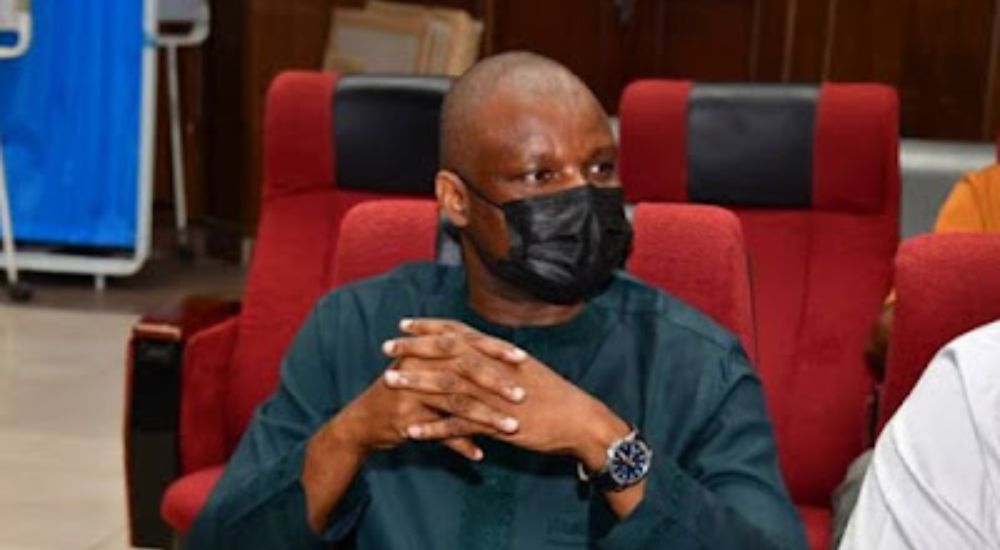
The Federal High Court in Abuja on Thursday ruled in favour of former head of the Police Intelligence Response Team (IRT), DCP Abba Kyari in the asset declaration case instituted against him and his siblings by the National Drug Law Enforcement Agency (NDLEA).
The NDLEA had filed a 23-count charge marked FHC/ABJ/CR/408/2022, against Kyari and his brothers – Mohammed Kyari and Ali Kyari – for allegedly failing to make full disclosure of their assets.
The court presided over by Justice James Omotosho in its judgement in the case in which Kyari and his brothers were listed as the first to third defendants said the prosecution failed to prove beyond reasonable doubts that the three houses at EFAB Metropolitan Estate Abuja belonged to him adding that Kyari had correctly filled these houses in his asset declaration as belonging to his wife.
Justice Omotosho in his 88-page judgement that lasted for almost three hours blamed the prosecution for being “too hasty” and embarking on “persecution”. He therefore ruled in favour of Kyari on all counts.
In the detailed judgement, the judge held that the prosecution failed to establish any credible link between Kyari and the alleged undeclared properties or financial offences. According to the court, “the burden of proof required in criminal trials — proof beyond reasonable doubt — was not met by the investigators.”
Justice Omotosho emphasised that the law recognises specific methods for proving ownership of landed property, including documentary title, acts of possession, long-term occupation, and other legally recognised indicators.
Advertisement
However, the prosecution, he said, failed to provide evidence under any of these established legal standards to demonstrate that the EFAB Metropolitan Estate houses were owned by Kyari.
The judge noted that evidence presented before the court showed that the properties in question were declared in Kyari’s asset declaration form as belonging to his spouse.
He added that the prosecution did not produce documents such as payment records, allocation papers, or ownership certificates linking Kyari personally to the properties.
Omotosho further ruled that “merely alleging ownership without concrete proof could not sustain criminal liability,” stressing that “the law requires clear evidence that the accused deliberately concealed assets.”
The court also addressed allegations relating to family properties linked to Kyari. It held that under Islamic inheritance principles, properties belonging to a deceased father may remain jointly owned by heirs until formally partitioned.
Advertisement
In such cases, the judge said, “individual heirs cannot claim exclusive ownership or be compelled to declare such properties as personal assets.”
Consequently, the court ruled that Kyari could not be held liable for failing to declare interests in family properties that had not been legally divided among beneficiaries.
On the money laundering allegations, the court held that the prosecution failed to establish any predicate offence that could justify a money laundering charge. According to the ruling, investigators did not demonstrate that the funds allegedly traced to Kyari originated from illegal activities.
The judge stated that without proof that the funds were proceeds of crime, the allegation of laundering could not stand. He also observed that conspiracy allegations require evidence showing a clear agreement between parties to commit an unlawful act, which the prosecution failed to provide.
Justice Omotosho also criticised aspects of the investigative process carried out by the NDLEA, particularly regarding the treatment of Kyari’s brothers, who were listed as the second and third defendants in the case.
According to the court, the agency did not provide them adequate opportunity to respond to allegations before initiating legal proceedings.
Advertisement
Evidence presented during the trial indicated that they were included in the case primarily because of properties associated with them, even though investigators admitted that their assets had not been fully examined at the time charges were filed.
The judge further observed that the defendants were not given sufficient time and freedom to properly complete and defend their asset declaration forms while under detention. He stressed that the law requires investigators to allow suspects adequate opportunity to explain their assets before concluding investigations.
Omotosho said failure to follow this procedure undermined the prosecution’s case and raised concerns about the fairness of the investigative process.
The court also reviewed bank account evidence presented by the NDLEA, which claimed that large sums of money passed through accounts linked to the defendants.
However, the judge ruled that the prosecution failed to prove that the transactions were illegal or connected to any criminal activity.
Without clear proof of unlawful origin of the funds, the court held that the financial records alone could not sustain the charges.
On the prosecution’s statement that about N200m was found in Kyari’s account, Justice Omotosho observed that the witness admitted that the analysis did not clearly separate Kyari’s salary and allowances from operational funds received through official channels.
The court further noted that “the prosecution did not establish the exact salary and allowances of the defendant” during the period under review “in order to enable the court to determine whether the funds were indeed above his legitimate earnings.”
The judge also pointed out that the financial analysis covered only the period between January 2022 and March 2022, despite the fact that the account under review had been opened since 2006.
The court stated that most of the deposits in the account during the period “were shown to have come from the Nigeria Police Force and the Central Bank of Nigeria.”
Justice Omotosho also noted that the prosecution did not investigate the process through which operational funds were sent from the Central Bank for police operations.
The court further observed that “there was no petition or complaint from either the Nigeria Police Force or the Central Bank alleging that Kyari had converted or misappropriated funds meant for operations.”
In his defence before the court, Kyari had explained that as commander of the Intelligence Response Team, operational funds were often sourced temporarily through personal arrangements due to the urgency of security operations.
According to him, “Officers sometimes had to borrow money from friends and family to immediately fund operations, while reimbursement from official sources could take between three and six months through the formal approval process.”
He told the court that “once operational funds were eventually released through official channels, the borrowed money would then be repaid.”
The court stated that this explanation was supported by evidence before it and described the defendant’s testimony as detailed and direct.
Justice Omotosho said the explanation provided by Kyari introduced material doubt into the prosecution’s claims regarding alleged conversion of funds.
The court also noted that the defendant did not operate multiple bank accounts under false names and that the accounts examined were linked to his verified identity.
On allegations relating to conversion of money and foreign currency transactions, Kyari told the court that at a certain period between February and March, he was under detention and did not have access to his phone or bank accounts.
He also stated that about £7,000 found in his account had been kept there for several years as a leftover from money used to treat his father abroad before his demise, and had been declared as part of his assets.
After reviewing the evidence, the court held that “the prosecution failed to establish that the funds in Kyari’s accounts were proceeds of unlawful activities or that he had converted operational funds for personal use.”
Justice Omotosho therefore ruled that the prosecution failed to prove the allegations relating to conversion of funds and money laundering.
Consequently, the court discharged and acquitted the defendant on counts 15, 18, 20, 21 and 25 of the charges.
The judge lambasted the FG in his summary of judgement noting that “Kyari had served the country bravely and had undertaken dangerous assignments in the course of ensuring national security to be rushed to court and treated this way. It’s persecution.”
According to Justice Omotosho, “there is nothing before this court to justify holding the defendant liable,” stressing that “the charges are not supported by credible evidence.”
Justice Omotosho therefore ruled that there was no case for the defendant to answer and ordered that Kyari be discharged.