
Kano Builders Turning To Donkeys To Cut Haulage Cost
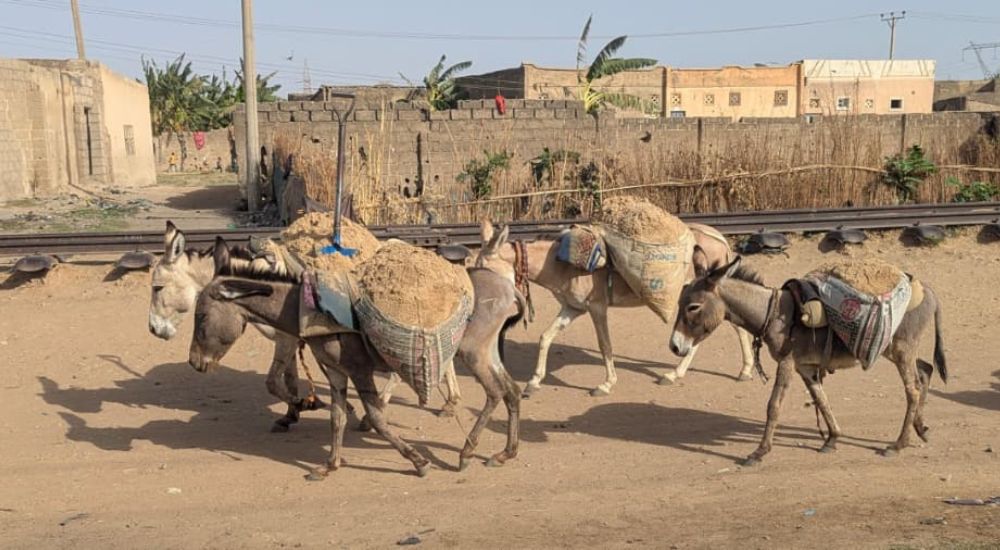
On a sun-baked morning along the sand-laden tracks of Gaida, Kumbosto LGA, on the rural fringe of Kano State, Musa Isyaku loads the last of four woven sacks onto the back of his donkey, cinches the rope tight, and clicks his tongue.
The animal lumbers forward without protest, carrying what little hope its owner has of making a living in an economy that has made every litre of petrol a luxury.
Isyaku, 22, has been a donkey handler for nearly two decades, but nothing in those years prepared him for the surge in demand he is now experiencing.
Where he once competed quietly at the margins of a market dominated by trucks, he is today the preferred haulier for dozens of households across his community seeking sand for building construction.
“Before, they would laugh at us,” he says, pausing to wipe sweat from his brow.
“They would say, ‘Why are you using a donkey when there are trucks?’ Now those same people are calling my number first.”
Advertisement
The familiar rumble of Parker, MAN, and HOWO trucks that once dominated the dusty tracks leading into remote communities across Kano State is growing quieter.
In their place, an older, slower but far cheaper alternative has reclaimed the landscape — the donkey, now the unlikely backbone of sand haulage for builders priced out of motorised transport by the unrelenting surge in the cost of petrol.
Across rural communities in Kano State, residents sourcing sharp sand for construction are increasingly turning to donkey handlers, paying between N2,000 and N5,000 per trip depending on distance — a fraction of what it now costs to hire a truck.
A Parker truck, the smallest of the common commercial haulage vehicles, now goes for N35,000 per load, while a MAN truck commands N50,000 and the larger HOWO trucks charge as much as N80,000, with prices climbing further when the distance is considerable.
For low-income residents in remote areas where roads are poor and incomes are thin, the mathematics are brutal and the choice is clear.
Advertisement
The Truck Drivers Left Behind
Abdullahi Garba, 51, has operated a MAN diesel truck on the Kano corridors for eleven years.
He does not begrudge the donkey handlers their new customers.
He understands, he says, because he is losing his own livelihood at the same rate his customers are losing theirs.
“When diesel was cheap, I would make four or five trips a week easily,” Garba said, leaning against the chassis of his stationary truck outside a fuel station along Kano’s Ring Road.
“Now I am lucky to make two. And those two trips, by the time I buy fuel and pay for maintenance, what is left for me and my family?”
Advertisement
Garba says the customers who remain are almost exclusively contractors on government or commercial projects.
The ordinary man building a personal home in a village — his original customer base — has all but disappeared from his call log.
“They don’t even call to negotiate anymore,” he says. “They have just quietly moved on.”
The Builder’s Calculation
For Hajiya Rakiya Suleiman, a 38-year-old trader in Dambare, Ungogo LGA, building the two-room house she has planned for years has become an exercise in painful arithmetic.
She began sourcing materials eighteen months ago, setting aside small sums from her market stall income.
When she priced trucks last year, she was quoted N40,000 for a MAN load. She waited, hoping prices would ease. They did not.
“Now they are telling me N50,000 for the same truck,” she says, seated outside the half-completed block foundation of her home.
“Where will I find N50,000 at once? I am using the donkeys. It takes more trips, yes, but I pay N3,000 at a time. That I can manage.”
She estimates she has sourced sand through more than fifteen separate donkey trips over four months — a process that has slowed her construction significantly but kept it alive.
“If I waited for a truck, I would still be waiting,” she says.
The Dealers’ Dilemma
At the Hayi sand depot on the outskirts of Kano, Alhaji Sani Danladi has watched the composition of his clientele shift sharply.
Danladi, who has dealt in building aggregates for over two decades, said bulk truck purchases — once the standard — now account for a shrinking share of his transactions.
“The donkey people now come every day,” he says.
“Small quantities, many times. It is more work for me to manage, but what can I do? That is where the market has gone.”
He adds that the shift has affected not just how materials are transported but how they are sold. Customers who once bought in bulk to take advantage of truck loads are now buying incrementally, often disrupting the stock levels he maintains for larger orders.
“The whole value chain has changed,” Danladi says. “And not for the better.”
What the Experts Say
Economists and development watchers say the donkey-for-sand phenomenon is not merely a curiosity — it is a measurable signal of economic regression with serious implications for housing access and rural development.
Dr. Abubakar Nura, a development economist at Bayero University, Kano, who studies informal economy dynamics in Northern Nigeria, said the return to animal-powered haulage reflects a broader pattern of de-modernisation driven by fuel cost inflation.
“What we are seeing is a reversal of decades of progress in rural logistics.
“When communities can no longer afford mechanised transport for basic construction inputs, it affects not just the speed of building but the cost and quality of what gets built.
Shelter becomes even more unaffordable for those at the bottom of the income ladder.”
Eng. Sani Diso, a housing policy analyst, added that the indirect consequences extend further — delayed housing completion increases household exposure to poor living conditions and can compound health and productivity challenges in already-vulnerable communities.
“Governments need to understand that fuel pricing is not just a macroeconomic variable,” he says. “It reaches all the way down to a man deciding whether he can afford to put sand under his foundation this month.”
A Resilient, If Reluctant, Return
Back in Gaida, Musa Isyaku has completed his morning’s first delivery and is already loading up for a second run. He is grateful for the work, but he does not romanticise it.
“This is not what progress looks like,” he says quietly.
“Progress is when people can afford the trucks. What we have now is people surviving. That is different.”
As his donkey steadies itself under a fresh load and turns back toward the distant haze of sand dunes, the image captures something essential about Kano’s rural economy in this moment — resilient, resourceful, and straining under a weight that neither the animal nor its handler should have to carry alone.